
 40.965° N, 8.209° E


Complete guide
La Pelosa: beach guide
What the beach is like
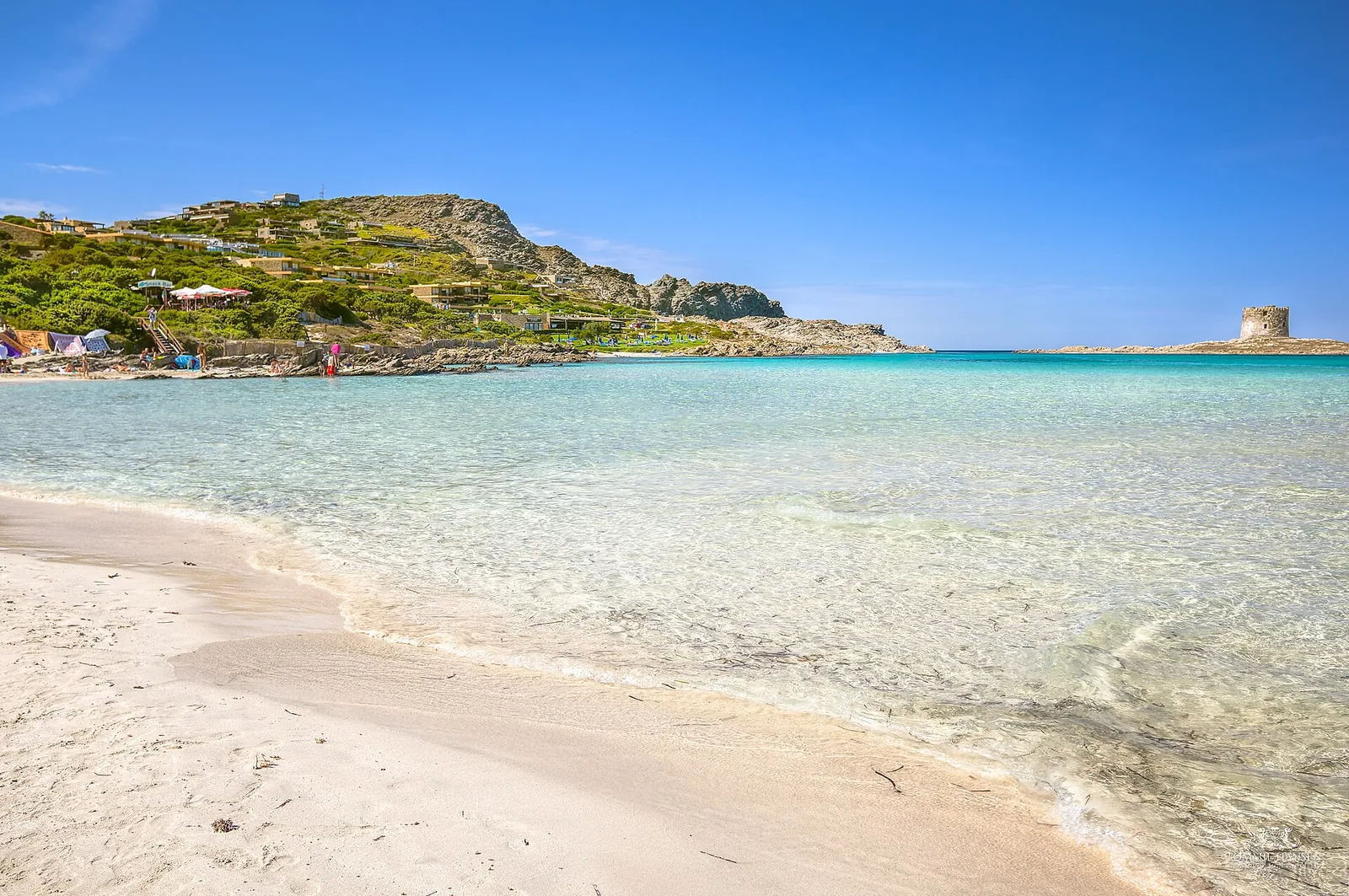
La Pelosa is a beach in the municipality of Stintino, at the far north-western tip of Sardinia, in the Gulf of Asinara. The sand is white and very fine, and the water stays ankle-deep for tens of metres. The colour of the sea shifts from pale blue and turquoise to emerald green, cobalt blue and finally deep blue. All around lie soft dunes covered with junipers and Mediterranean scrub.
The official tourism portal of the Sardinia Region calls it a world icon and reports that, in the judgement of travellers, it has several times been rated the best beach in Italy. According to the same portal, it was the beach that made Stintino famous, turning it from a fishing village into a well-known resort.
At the foot of a rugged headland of black schist lies an islet with the Pelosa tower, built in 1578 to control traffic towards the gulf and today a characteristic feature of the beach. The islet can be reached on foot, after crossing a small cove known as La Pelosetta. The regional portal describes the isola Piana and the dark sea stacks of Capo Falcone as a barrier that shields the beach from the force of the open sea.
Getting there
From Stintino, take provincial road 34 and, close to the beach, turn right onto viale La Pelosa. Stintino lies 3.2 km south-east of the beach as the crow flies. According to the regional portal, the road linking the beach to the village, which is served by shuttle buses, is about three and a half kilometres long and can be cycled. The same portal places the car park a few metres from the beach.
When to go
The regional portal notes that the beach is extremely crowded in July and August and that it is better to visit in the low season. Over the decades the beach has undergone changes and erosion, partly because of the large number of visitors. In the busiest months it is worth checking the entry arrangements in force in advance.
Judging by the orientation of the coast, the beach faces north. According to QualeSpiaggia data it is exposed to the north wind (tramontana) and the north-east wind (grecale), which come in from the sea; it is instead sheltered from the south-east wind (scirocco), the south wind (ostro) and the south-west wind (libeccio), which blow from the land. This is an indication derived from the orientation, not a forecast.
Seabed and sea
The water is clear and very shallow. Behind the isola Piana, so flat that it does not hide them, the rocks of the Asinara remain in view. The beach looks out over the Sea of Sardinia. In the 2025 season the European Environment Agency rated the bathing water quality as excellent.
Facilities and free beach
La Pelosa is free for more than half of its length, while the rest is taken up by a beach establishment with deckchairs, sunloungers and umbrellas. Rubber dinghies and jet skis can also be hired. In the village and along the road to the beach there are places to stay and restaurants. Wooden boardwalks and barriers prevent access to the dunes.
Rules and protected areas
In 2026 entry to the beach was limited in number: in May the Comune di Stintino announced that bookings for tickets were open on the spiaggialapelosa.it website. Before setting off it is worth checking the rules in force on the municipality's website.
The municipal regulation approved on 23 May 2018 contains specific provisions for the Spiaggia La Pelosa area. Beach towels may only be used with a mat of wood, plastic or another material between the towel and the sand, so as not to encourage the removal of sand. Smoking is allowed only on viale La Pelosa or right next to the municipal ashtrays, in any case within 3 metres. When leaving the beach, feet and belongings that have touched the sand must be rinsed at the stations at the end of the boardwalks, without soap or detergents. It is forbidden to enter or cross the dunes behind the beach and to use the fences and reed screens that protect them. Trading, including itinerant trading, is also forbidden in the area. For breaches of these provisions the 2018 regulation sets a fine of 25 to 500 euros.
On all the beaches of the municipality the same regulation forbids occupying the 5-metre strip along the shoreline, reserved for free passage, with umbrellas or towels. It also forbids removing any natural element of the beach, using soap and shampoo, and leaving umbrellas and deckchairs on the free beaches after sunset. The same regulation also forbids taking animals onto the beach between the hours of 8 and 20, apart from the stated exceptions such as guide dogs.
With children
The regional portal considers the beach perfect for families with children, thanks to the clear and very shallow water. For small children it is useful to bring shade from the sun and enough water.
Nearby
Capo Falcone is the far north-western tip of Sardinia, a rugged headland of black schist in whose crevices the peregrine falcon nests. The cape is reached by going past the Pelosa beach and turning right after a short stretch of bends. At the top stands the Falcone tower, dating from 1537, which can be reached by mountain bike. From a terrace 200 metres high you can see, on one side, the sheer cliffs above the outer sea and, on the other, the inner sea, calm and nicknamed the sea of seven colours.
6.9 km south as the crow flies lies Le Saline, a beach formed by a long strip of small white pebbles between the sea, a lagoon and the old salt pans, with a large car park. The regional portal lists organised excursions from Stintino to the Asinara, today a national park in the territory of Porto Torres. Stintino was originally very similar to Cala d'Oliva, a village on the Asinara from which came the 45 families of Ligurian origin who, when the island became a penal colony in 1885, settled on a strip of land between two inlets. In the village, the museo delle Tonnare, set up in a tuna fishery that was active until the seventies, tells the story of tuna fishing and processing.
Sources
- La Pelosa | SardegnaTurismo - Sito ufficiale del turismo della Regione Sardegna
- QualeSpiaggia — open data spiagge (CC BY 4.0)
- OpenStreetMap
- EEA — Bathing water quality 2025 (IT020090089006)
- Comune di Stintino — Prenotazione accesso numero chiuso spiaggia La Pelosa (2026)
- Comune di Stintino — Regolamento di disciplina per la fruizione delle aree demaniali marittime (2018)
- Capo Falcone | SardegnaTurismo - Sito ufficiale del turismo della Regione Sardegna
- Le Saline - Stintino | SardegnaTurismo - Sito ufficiale del turismo della Regione Sardegna