
 38.184° N, 15.638° E


Complete guide
Lido di Catona: beach guide
What the beach is like
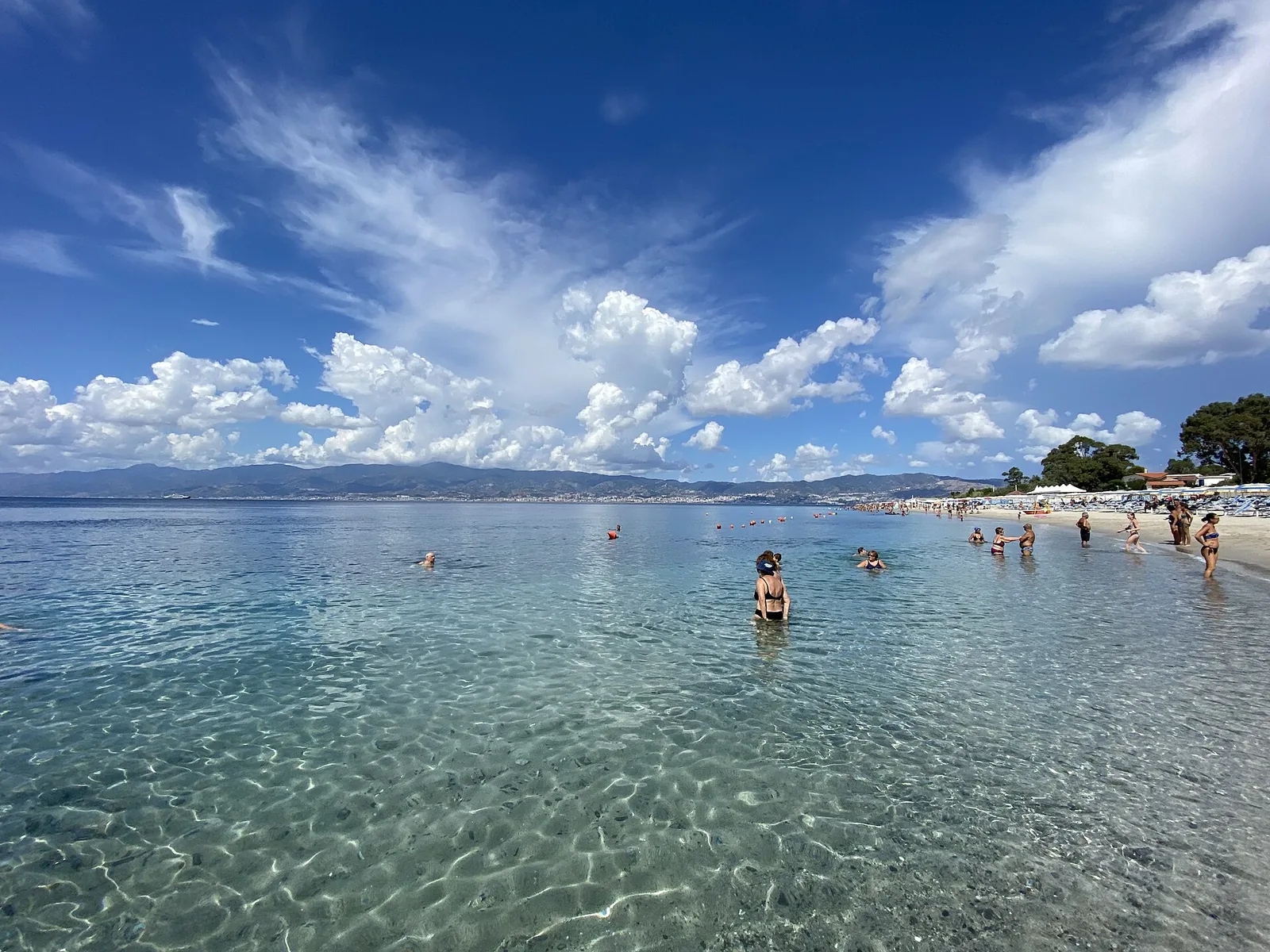
Catona beach lies in the northernmost district of Reggio Calabria and looks out over the Strait of Messina. The beach is 1.5 km long and made of white, medium-grained sand. Wikipedia describes it as pleasant for bathers.
A peculiarity of the beach is that digging a hole in the sand is enough to find fresh water, even at the shoreline. Some link this phenomenon to the miracle of Saint Francis of Paola (San Francesco di Paola). According to legend, in 1464 Francis of Paola, unable to pay for the crossing, set off from Catona beach and crossed the Strait on his own cloak together with a fellow friar. A well-known depiction of the event is the tapestry by Edward Steinle kept in the Vatican, in the Gallery of Maps (Galleria delle Carte Geografiche).
The miracle is commemorated on the Catona seafront by a monument of about 15 m, the work of G. Polimeni. In 2019 a decree of the Calabria Region granted the Santuario San Francesco in Catona a contribution of thirty thousand euros for the restoration of the monument dedicated to Saint Francis of Paola on the Lungomare Laganà. According to the Italian Wikipedia, another sandstone statue, carved in 1702, stands at the point on the coast where the miracle is said to have taken place. The English Wikipedia, however, reports that after the seafront was extended the work was moved about a hundred metres from the shore, onto private property, and can no longer be visited.
Getting there
According to Wikipedia, Catona is connected to the centre of Reggio Calabria by bus lines 102 Catona Concessa-Terminal Botteghelle, 103 Catona Bolano - Terminal Botteghelle and 101 Arghillà Sud - Piazza Garibaldi. Alternatively, there are Catona railway station and the connection to the A2 motorway. Villa San Giovanni, where according to Wikivoyage the boats for Messina leave from, lies 3.8 km as the crow flies north of the beach. It is worth checking public transport connections in advance.
When to go
The sea at Catona is normally calm, unless the sirocco (scirocco) is blowing. From the orientation of the coast, according to QualeSpiaggia data, the shore faces south-west. With the north wind (tramontana), the north-east wind (grecale) and the east wind (levante) the wind blows from the land: the beach is sheltered and the sea close to shore tends to be calmer. With the south wind (ostro), the south-west wind (libeccio) and the west wind (ponente), on the other hand, the wind comes from the sea: the beach is exposed and waves can build up. The sirocco and the mistral (maestrale) blow across the shore. This is an indication, not a forecast.
Seabed and sea
The water is transparent and cold. In the 2025 season the European Environment Agency rated the bathing water quality at the monitoring point associated with the beach as good. Among the protected habitats in the municipal territory, the technical rules of the Reggio Calabria municipal beach plan (piano comunale spiaggia, PCS) also mention the SCI of the seabeds from Punta Pezzo to Capo dell'Armi. When the sea is rough it is wise to stay within your depth.
Facilities and free beach
Among the facilities in Catona, Wikipedia lists the Lido dello Stretto, opened in 1959. The same article lists, on the lido's beach, equipped play areas for children, two beach volleyball courts, toilets and showers, and, inside the complex, a bar and ice-cream parlour, a fast-food outlet and a dance hall.
The technical rules of the PCS include the Lungomare Catona among the equipped public areas, used mainly as pedestrian and cycle paths, with greenery and street furniture. The plan's aims include free use of the coastline and not allowing exclusively private uses of the state-owned coastal strip. It is worth checking the available services beforehand or bringing your own umbrella and water.
Rules and protected areas
Catona beach is one of the Sites of Community Importance, with the code IT9350183. The technical rules of the PCS place the SCI of the Catona beaches at the northern end of the municipality's state-owned coastal area. The site is recognised as being of Community interest for its coastal dune habitats, which according to the plan are altered and degraded because the dune ridge and the beach have been levelled. For this area the plan provides for a single protection and enhancement project covering the whole SCI, to be drawn up together with the managing body, the Metropolitan City of Reggio Calabria (Città Metropolitana di Reggio Calabria). Among other things, the project must include raised wooden boardwalks, barriers protecting the dunes and information signs on the value of the SCI. Within the SCI the rules do not allow levelling the beach with machinery, removing sediment or plant species, or opening new unauthorised gaps or paths. On the dunes it is best to use existing paths and not to take away sand or plants.
Nearby
The centre of the Catona district lies 0.6 km as the crow flies north-east of the beach. The Catona district was an independent municipality from 1811 to 1927. In Roman times, the boarding station for Sicily known as "ad fretum ad statuam" is believed to have been at Catona, where the Via Popilia arrived. Dante Alighieri mentions Catona in canto VIII of the Paradiso, as the southern extremity of the kingdom.
According to Wikipedia, on the Catona seafront the Arena Alberto Neri hosts the Catonateatro festival every year, with theatre and music events. The arena, built in the 1990s, can hold more than 1,200 spectators. Gallico Marina lies 2 km as the crow flies south of the beach. On the other side of the Strait, Messina is 7.4 km as the crow flies to the west. According to Wikivoyage, Reggio is home to the rare optical phenomenon of the Fata Morgana, during which the Sicilian coast appears to be only a few metres away.