
 39.542° N, 8.449° E


Complete guide
Piscinas: beach guide
What the beach is like
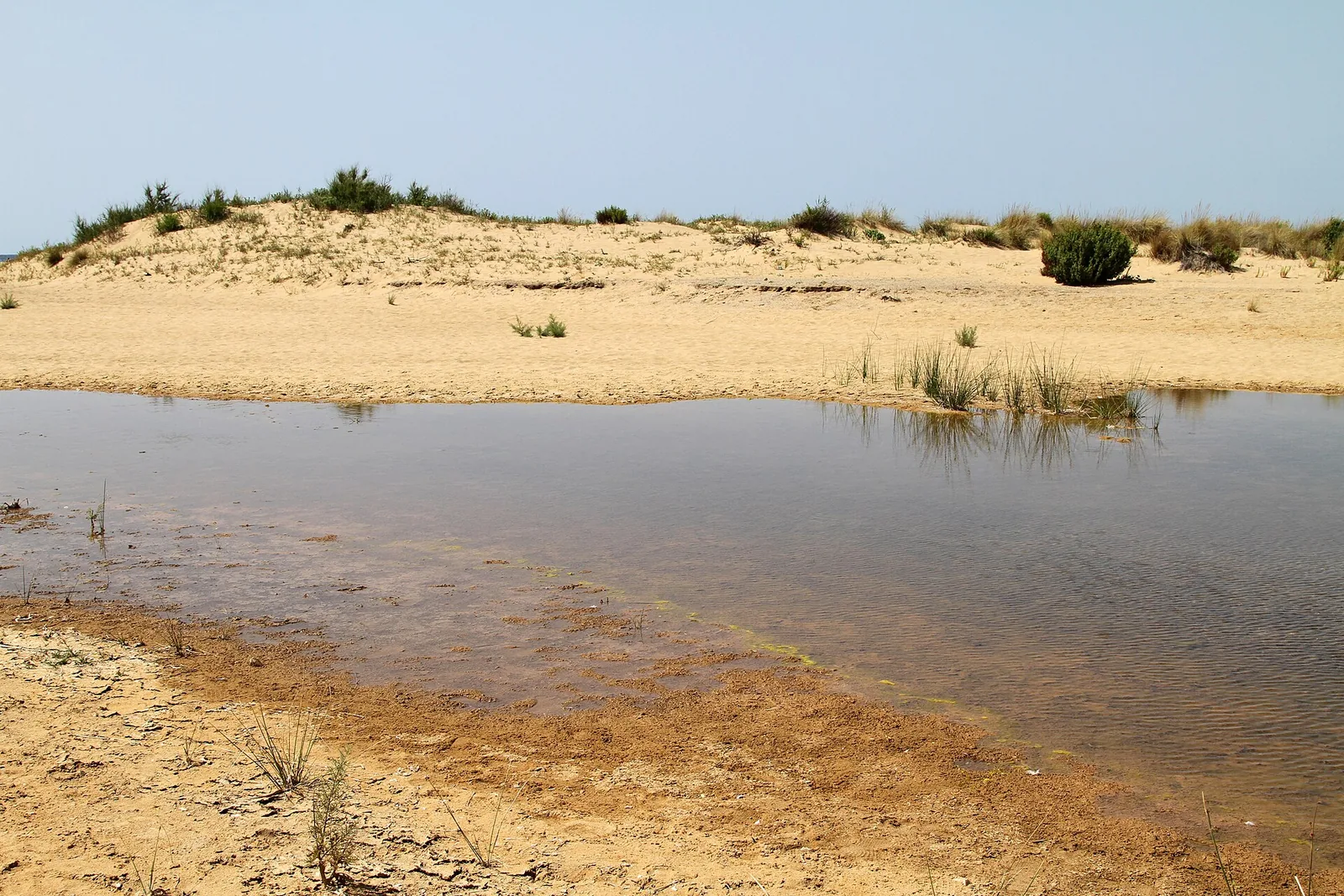
Piscinas is a beach on the Costa Verde, in the municipality of Arbus, in south-western Sardinia. It faces the Sardinian Sea. It should not be confused with the municipality of Piscinas, in the Sulcis. The regional tourism portal describes an expanse of golden sand seven kilometres long, reached after dirt and sandy tracks. The same portal reports that National Geographic has listed it among the most beautiful beaches in the world. The beach is sandy.
The coastal dune system of the Dune di Piscinas covers about 28 square kilometres. According to Wikipedia, the dunes reach about two kilometres inland from the coast, rise to a height of about 100 metres and are shaped by the winds blowing from the sea. The regional portal instead gives dunes up to 60 metres high, shaped by the north-west wind (maestrale). According to Wikipedia they are among the highest living dunes in Europe. The area slopes gently from some low hills down to the coastline, passing from rock formations to sand dunes.
The vegetation includes juniper, mastic, broom and spurge. Wild olive also grows there, along with, in spring, stock, sea daffodil and sand poppy. The animals include the Sardinian deer, Hermann's tortoise (Testudo hermanni) and the loggerhead sea turtle Caretta caretta, which lays its eggs on the beach.
Getting there
From Arbus you take provincial road 65, pass Marina di Gutturu Flumini, Marina di Arbus and Portu Maga, then turn right towards the beach. Another road goes down from Ingurtosu to the sea through the valle de is Animas, among the remains of the mining settlements. As the crow flies, Arbus is 12.9 km east of the beach and Guspini 15.8 km to the east. From Cagliari you take the SS 131 to km 46, exit at Sanluri-Guspini-Arbus, follow the SS 197 to Guspini and from there the SS 126 to Arbus. According to Wikivoyage, ARST buses run from Cagliari to Arbus.
When to go
Judging from the orientation of the coast, the beach faces west. With the south-west wind (libeccio), the west wind (ponente) and the north-west wind (maestrale), the wind blows in from the sea and the beach is exposed to waves. With the north-east wind (grecale), the east wind (levante) and the south-east wind (scirocco), the wind blows from the land and the beach is sheltered, with calmer water close to shore. The north wind (tramontana) and the south wind (ostro) hit it from the side. This is an indication, not a forecast.
The sea on the Costa Verde is rarely calm and must always be respected. The constant wind raises long, high waves, and windsurfing, kitesurfing and board surfing are practised even in winter. According to the regional portal, the size of the beach always allows for quiet seclusion; the towns are very far away.
Seabed and sea
The seabed becomes deep almost immediately, in a stepped pattern: from a minimum of two to three metres it soon reaches tens of metres. 200 metres offshore lies the wreck of an English ship that has lain there for three centuries and can be explored by divers. The mouths of two streams draw fish hunting grey mullet towards the shore, and the catches reported for surfcasting are striped seabream, shi drum and gilthead bream. In the 2025 season the European Environment Agency rated the bathing water quality as excellent. When the sea is rough it is best to stay close to the shore, and weak swimmers should avoid going in.
Facilities and free beach
According to the regional portal, accommodation is limited: a campsite and a hotel right by the dunes. On the beach there are two kiosk restaurants, and beach equipment, canoes, pedal boats and dinghies can be rented. The parking area is also equipped for campervans.
According to Wikipedia, the only building at Piscinas is the mining warehouse of the Gennamari and Ingurtosu mines, declared a national monument in 1985. After its use as a warehouse it became a seaside holiday camp for the children of the mine employees, and in the early '90s the ruin was turned into a hotel. The entrance of the Le Dune hotel is still the original tunnel.
Rules and protected areas
According to the regional portal, a large stretch of 800 metres officially became the largest naturist beach in Europe in 2018. The disused mines in the territory of Arbus are part of the historical and environmental geomining park of Sardinia. On the dunes it is best to walk on existing paths and not to disturb the wildlife.
Nearby
The village of Ingurtosu, a hamlet of Arbus, was one of the largest and most productive mines in Sardinia and lies in the valle de is Animas, which reaches as far as the dunes of Piscinas. From 1855 to 1968 silver, lead and zinc were mined there. Along the valley there were seven hamlets with 900 rooms, which housed up to 2,500 workers and their families. The management building, in granite and in neo-medieval style, known as the castle, dates from 1870. Ingurtosu is part of the geomining park and in 1997 was included in the Unesco geoparks network.
The ore arrived from the Brassey washing plant at Naracauli in small wagons, along a railway section a few kilometres long. From Piscinas it was taken by sailing barges to Carloforte, on the island of San Pietro. In the dunes, the regional portal writes, rails and wagons can still be seen. The rio Piscinas is also fed by water from some tunnels of the disused mines, which give it a reddish colour, and for this reason it is sometimes called the fiume Rosso.
Further north on the same coast lies Portu Maga. Scivu, 6.4 km to the south-west as the crow flies, has three kilometres of dunes and is called the talking beach because of the echo heard when walking on it. Arbus has a stretch of coastline 47 kilometres long.
In autumn 1977 several scenes of the film Black Stallion, directed by Carroll Ballard and produced by Francis Ford Coppola, were shot at Piscinas. In 2023 the music video for Marco Mengoni's single Due vite was filmed at the dunes.
Sources
- Piscinas - Costa Verde | SardegnaTurismo - Sito ufficiale del turismo della Regione Sardegna
- QualeSpiaggia — open data spiagge (CC BY 4.0)
- Wikipedia (it) — Dune di Piscinas
- OpenStreetMap
- Wikivoyage (en) — Arbus
- Arbus | SardegnaTurismo - Sito ufficiale del turismo della Regione Sardegna
- EEA — Bathing water quality 2025 (IT020106001002)
- Wikipedia (it) — Arbus (Italia)
- Ingurtosu | SardegnaTurismo - Sito ufficiale del turismo della Regione Sardegna