
 39.493° N, 8.410° E


Complete guide
Scivu: beach guide
What the beach is like
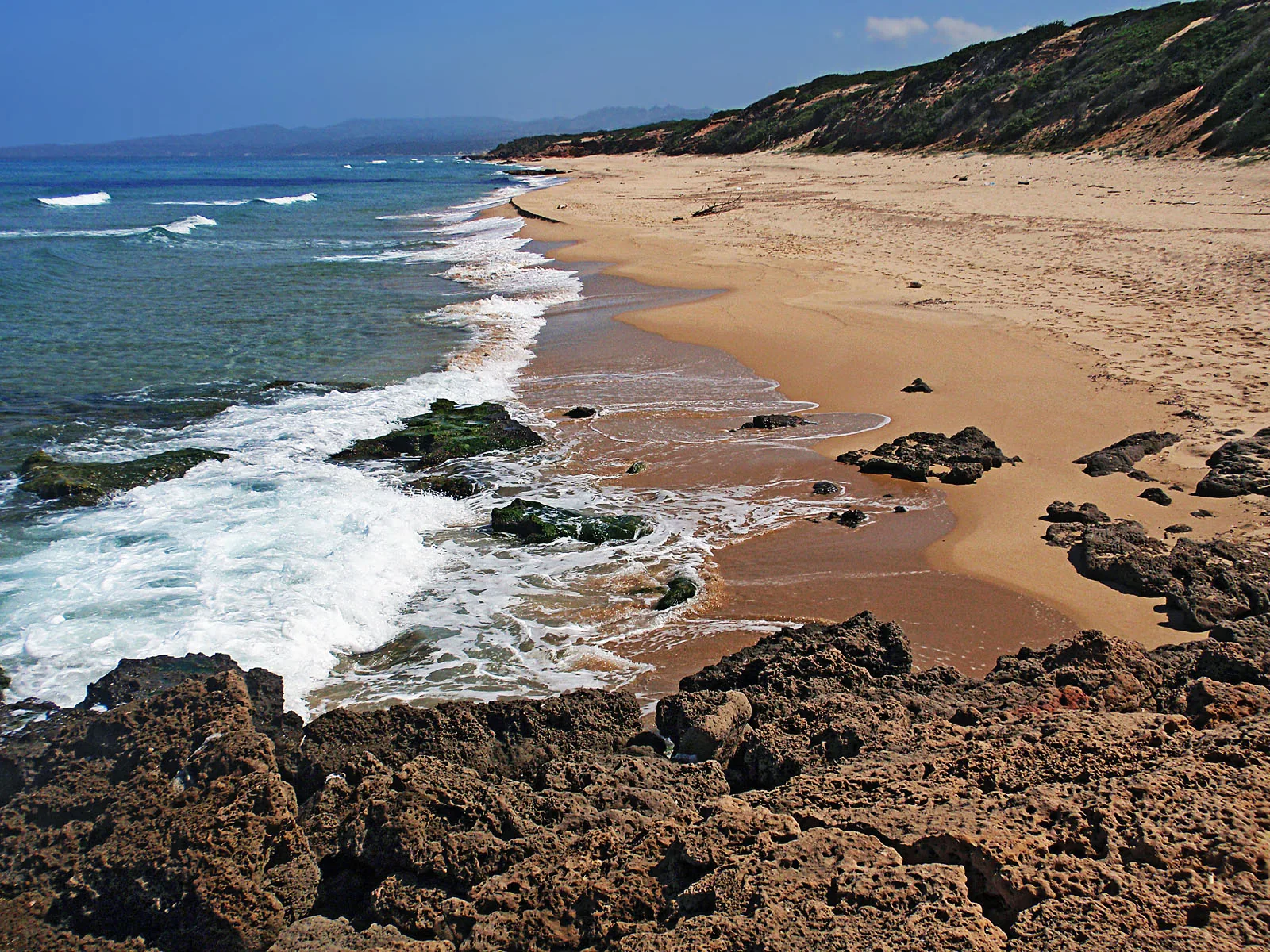
Scivu is a beach in western Sardinia, in the municipality of Arbus, and is part of the Costa Verde. Wikipedia lists it as one of the main beaches in Sardinia. The beach is a three-kilometre strip of fine, soft golden sand, broken only by a small reef. The sand is called "talking" because of the echo it makes when you walk on it.
Behind the beach lie dunes dotted with junipers, mastic shrubs, broom and sea daffodils. On the sides and behind the beach rise reddish rocks covered in Mediterranean scrub, which runs down from the mountains to the sea. The beach is bounded to the north by the dunes of Piscinas and to the south by capo Pecora.
The name Scivu comes from the sand slide (scivolo) you have to cross to reach the beach. Along the shore there is a cave where the sound of the sea echoes between the rocks, creating a distinctive acoustic effect. Scivu is an isolated place, far from inhabited areas and not easy to reach. The regional portal calls it very busy in summer, but never crowded.
Getting there
To get to Scivu, you take the Strada Statale 126 from Arbus towards Fluminimaggiore, keeping right until you turn onto the Strada Comunale Scivu, which you follow to the end. There is a large car park, also equipped for campervans. From the parking area you reach the sand on foot, along a panoramic boardwalk that crosses dunes and vegetation.
Fluminimaggiore lies 9.6 km as the crow flies south-east of the beach, Buggerru 10.7 km to the south. By public transport, the town of Arbus can instead be reached by ARST bus from Cagliari, or by train to San Gavino and then by bus.
The regional portal also describes a walking route that reaches Scivu from capo Pecora: a trek that is long, twelve kilometres, but not demanding, on paths and mule tracks overlooking the sea. The route crosses the nature reserve of the uninhabited headland and in the last stretch descends steep slopes down to the beach.
When to go
Scivu beach faces north-west and looks out onto the Sea of Sardinia (Mar di Sardegna). With the tramontane (tramontana), the west wind (ponente) and the mistral (maestrale), the wind blows from the sea and the beach is exposed to the waves. With the east wind (levante), the sirocco (scirocco) and the south wind (ostro), the wind blows from the land and the sea near the shore tends to be calmer. The gregale (grecale) and the libeccio (libeccio) hit it from the side. This is an indication based on the orientation of the coast, not a forecast.
The regional portal warns that the sea of the Costa Verde is rarely calm and should be approached with caution. When the mistral blows steadily, Scivu becomes a destination for wave surfing, windsurfing and kitesurfing, visited by surfers in winter too. According to the regional portal, the atmosphere is special all year round and the most seductive moment is sunset, when the sand and the rock walls turn red.
Seabed and sea
The seabed is sandy near the shore and more varied further out, with channels, sandbanks and scattered rocks. The seabed lends itself to snorkelling and diving. The colour of the water ranges between emerald green and deep blue. In the 2025 season the water at Scivu was rated excellent by the EEA.
These waters are home to sand steenbras, gilthead bream, sea bass, corb and amberjack, and the regional portal lists the spot as one of the best known for surf-casting. For fishing, according to the same source, the best moment is just after the mistral stops.
Facilities and free beach
Besides the car park, there are a refreshment point and rental of beach equipment, pedal boats, canoes and inflatable boats. When the sea is rough, it is wise to think carefully before going into the water.
Rules and protected areas
The shoreline is part of a WWF oasis, which lies within the geo-mining park of Sardinia and the sites of community importance of Capo Pecora and of the Scivu and Piscinas dune system, 600 hectares in all. In the area you can see the Sardinian deer. The oasis includes a 150-hectare cork oak wood, flown over by peregrine falcons, kestrels and buzzards. It is best to stay on the boardwalk and the marked paths.
Nearby
Piscinas beach lies 3 km as the crow flies to the north-east. The dunes of Piscinas are a yellow-ochre desert shaped by the wind, of which Scivu is the natural southern continuation; at Piscinas, however, the dunes reach inland. According to Wikipedia, the Piscinas dune system is one of the largest in Europe.
Capo Pecora marks the southern end of the beach. The headland has isolated cliffs, popular with spearfishers, and a granite composition, unusual on a coast dominated by limestone. Cala Is Tramatzus is 3.9 km as the crow flies to the south-west, Portixeddu beach 6 km to the south.
In the municipality of Arbus, the hamlets of Ingurtosu and Montevecchio preserve the disused nineteenth- and twentieth-century mines, now part of the historical and environmental geo-mining park of Sardinia. The Costa Verde, along the roughly 50 kilometres of the Marina di Arbus, includes Capo Frasca and Capo Pecora.
Sources
- Wikipedia (it) — Spiaggia di Scivu
- Wikipedia (it) — Arbus (Italia)
- Wikivoyage (en) — Arbus
- OpenStreetMap
- EEA — Bathing water quality 2025 (IT020106001009)
- QualeSpiaggia — open data spiagge (CC BY 4.0)
- Scivu | SardegnaTurismo - Sito ufficiale del turismo della Regione Sardegna
- Marina di Arbus | SardegnaTurismo - Sito ufficiale del turismo della Regione Sardegna