
 40.584° N, 8.257° E


Complete guide
Spiaggia delle Bombarde: beach guide
What the beach is like
Le Bombarde is a beach in north-western Sardinia, in the municipality of Alghero. According to SardegnaTurismo, the official tourism website of the Sardinia Region, it is one of the best-known beaches of the Riviera del Corallo. It is a sandy beach on the Mar di Sardegna, facing south-east.
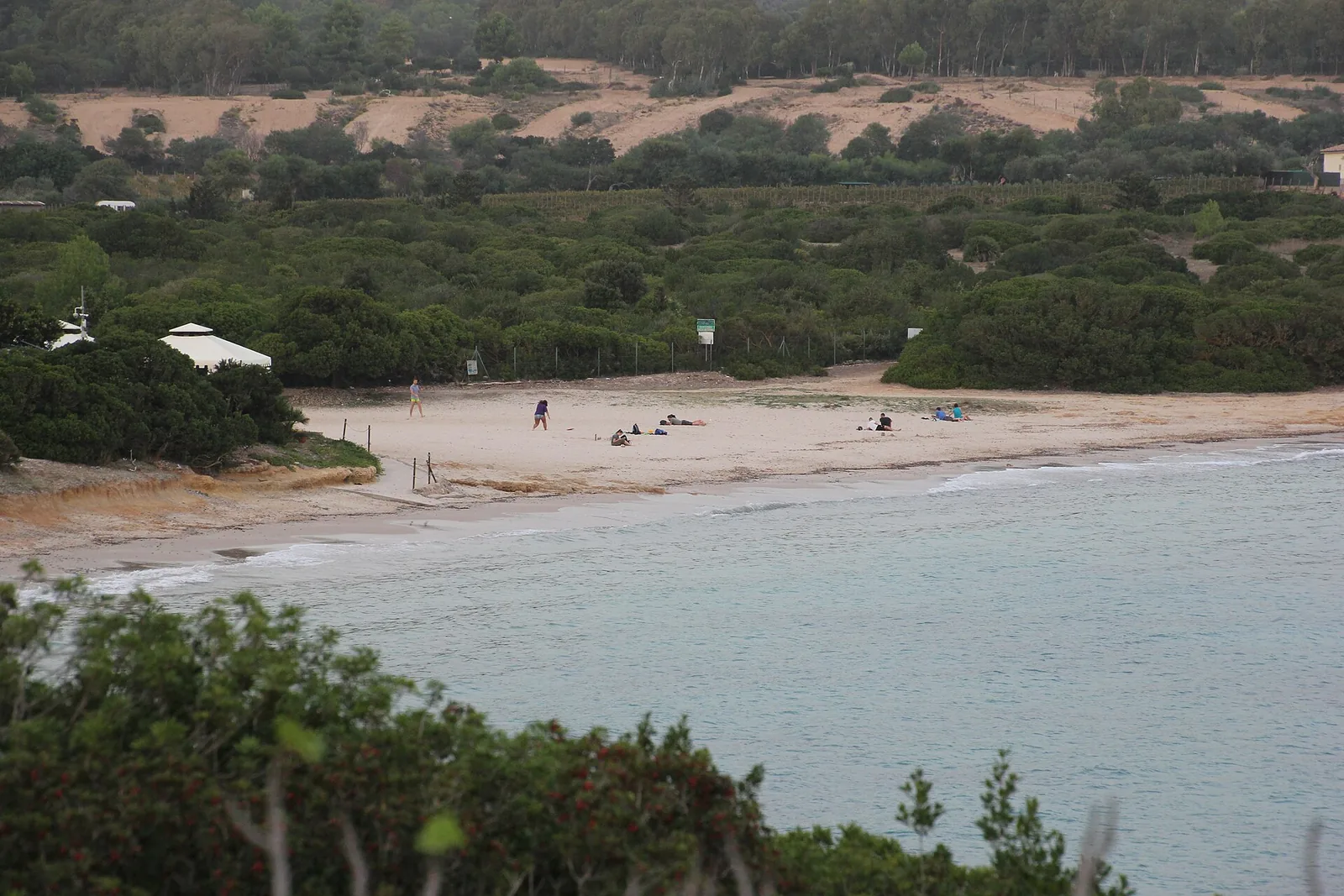
The beach is a sandy crescent almost one kilometre long, framed by volcanic rocks. The sand is very fine and light, with ochre hues. At both ends the beach is bounded by reddish cliffs. Behind it there is a wood of maritime pines, eucalyptus and Mediterranean scrub shrubs, part of the Porto Conte regional park. The wood is called the pineta delle Bombarde, and the most common plant species in the area are maritime pine, eucalyptus and Mediterranean scrub.
According to Wikipedia the beach is very well known both to Sardinians and to people coming from the mainland.
Getting there
From Alghero the beach is reached by passing the village of Fertilia on the SS 127 bis: shortly after the km 44 sign you will see the sign for the beach. Fertilia lies 2.5 km as the crow flies north-east of the beach. The centre of Alghero is 5.7 km as the crow flies to the south-east.
For those arriving by plane, the airport is five kilometres from the village of Fertilia. In 2023 the English Wikivoyage reported regional buses from the airport to Alghero every hour, with a 20-minute journey. Alghero station is served by the ARST Sassari-Alghero line. In summer it is worth setting off early and bringing enough water.
When to go
With the east wind (levante), the sirocco (scirocco) and the south wind (ostro) the wind comes from the sea and the beach is exposed to waves and rough sea. With the north wind (tramontana), the west wind (ponente) and the mistral (maestrale) the wind blows from the land and the beach is sheltered, with the sea generally calmer near the shore. The north-east wind (grecale) and the south-west wind (libeccio) arrive crosswise instead. These are indications based on the orientation of the coast, not weather forecasts. Monte Doglia and the hills form a barrier against the mistral.
The regional circular for the 2026 bathing season sets the start of the season in Sardinia on 1 May and the end on 30 September of each year.
Seabed and sea
In the 2025 season the European Environment Agency (EEA) rated the bathing water quality of this stretch as excellent. The sandy seabed drops quickly: a few metres from the shore the water is already deep. Anyone who is not a confident swimmer should stay within their depth.
The beach has always been subject to erosion and subsequent advance. In the years from 2008 to 2010 the beach retreated considerably, almost to record levels, while in the early 2000s it was completely intact. In early September 2010 a beach nourishment project was proposed to bring back to the beach the sand that had accumulated in the sea.
Facilities and free beach
In the northern part there are beach clubs, hotels, a campsite, a bar and a restaurant. The car park is large and scuba diving and windsurfing are possible. Wikipedia mentions a paid car park for cars and motorbikes above the beach. Several kiosk bar-restaurants have been built over the years to serve bathers who are not staying at the hotel.
Rules and protected areas
Before being included in the protected area the pine wood suffered from rubbish dumping, while environmental restoration is now under way. Wikipedia reports that almost every summer the area between this beach and Fertilia is overrun by wild boar, and that for this reason the regional park allows the culling of surplus animals at the appropriate times. The 2026 regional circular on bathing asks municipalities to display, at easily accessible points and on dedicated signs, information such as the length of the bathing season, the quality classification and any temporary bathing bans. In the pine wood it is good practice not to leave any litter.
Nearby
The Spiaggia del Lazzaretto lies 0.8 km as the crow flies to the west. The actual beach of Lazzaretto is just over 300 metres long. On the eastern side there are rocks breaking the surface, while in the opposite direction the sand, generally medium to fine-grained, is mixed with the odd pebble.
The Palmavera nuragic complex stands on the promontory of the same name, one and a half kilometres from the sea, inside the Porto Conte park. The complex is built of limestone and sandstone blocks and includes a central building with two towers, an outer wall and the huts of a village. Today there are fewer than 50 huts, while originally there are estimated to have been between 150 and 200.
Fertilia, a frazione of Alghero, was the last "city of the Duce" built on the island, after Mussolinia (later Arborea) and Carbonia. The village was built by the Fascist government after the draining of the marshes that covered the area, to a design by the architect Arturo Miraglia.
Punta Negra lies 1.9 km as the crow flies to the north-east. The Spiaggia di Maria Pia is 3.9 km as the crow flies to the east, with sand dunes covered with centuries-old junipers. The Spiaggia Mugoni, 6.1 km as the crow flies to the north-west, is wide and calm, in the bay of Porto Conte. The places around Alghero also include the Grotte di Nettuno, on the north-western side of the Capo Caccia promontory. According to the English Wikivoyage, the area of the Capo Caccia and Isola Piana marine reserve is one of the best diving destinations in Europe.
Sources
- Wikipedia (it) — Spiaggia delle Bombarde
- Le Bombarde | SardegnaTurismo - Sito ufficiale del turismo della Regione Sardegna
- QualeSpiaggia — open data spiagge (CC BY 4.0)
- OpenStreetMap
- Fertilia | SardegnaTurismo - Sito ufficiale del turismo della Regione Sardegna
- Wikivoyage (en) — Alghero
- Wikivoyage (it) — Alghero
- autoritadibacino.regione.sardegna.it — Circolare-della-Balneazione-2026_Rep.-2-prot.-4555-del-23.04.2026.pdf
- EEA — Bathing water quality 2025 (IT020090003005)
- Lazzaretto - Alghero | SardegnaTurismo - Sito ufficiale del turismo della Regione Sardegna
- Nuraghe Palmavera | SardegnaTurismo - Sito ufficiale del turismo della Regione Sardegna