
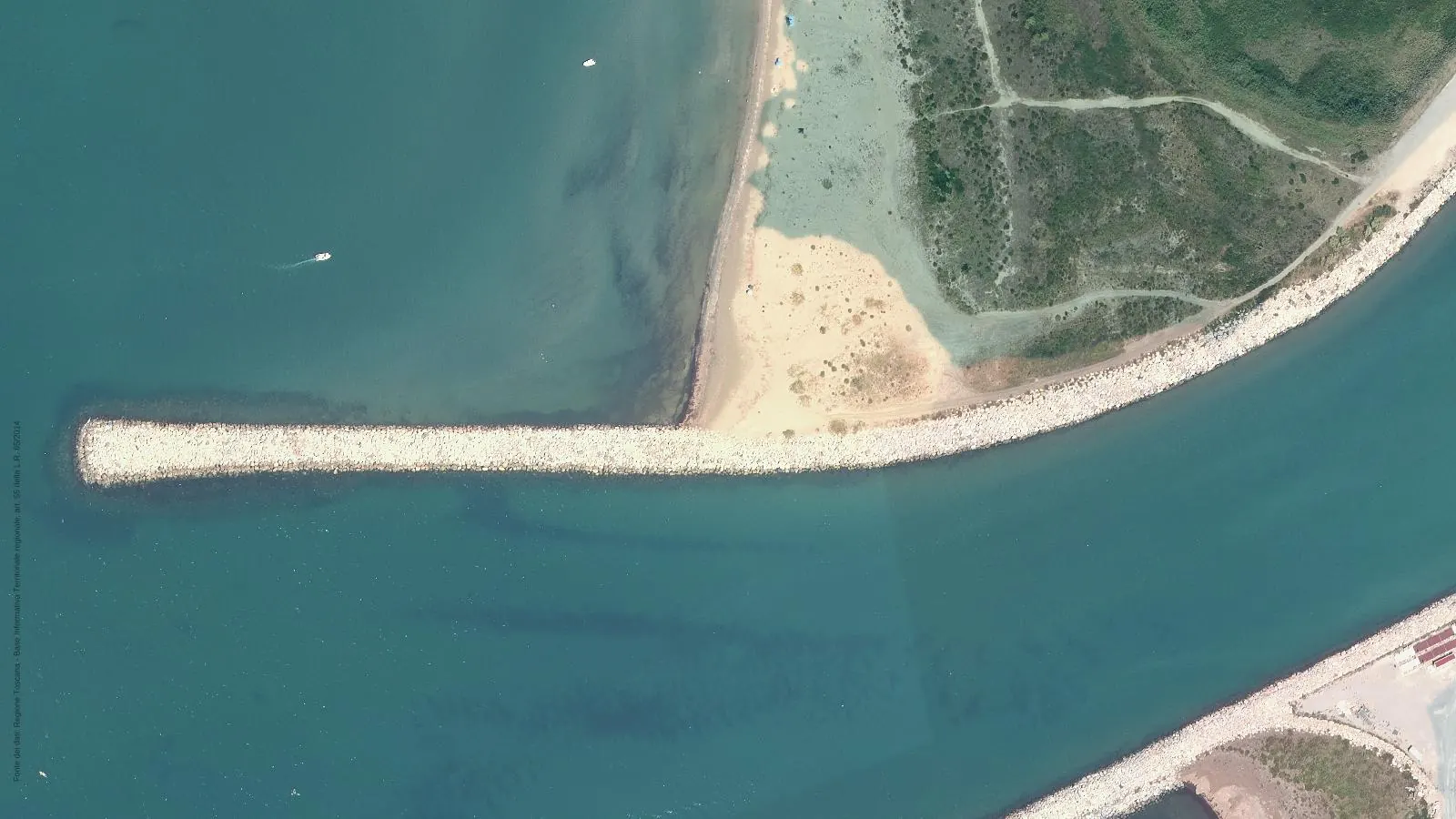
 43.596° N, 10.292° E


Complete guide
Calambrone beach: beach guide
What the beach is like
Calambrone beach lies in the hamlet of the same name in the municipality of Pisa, in Tuscany, on the Ligurian Sea. Calambrone stands on the Pisan coast, halfway between Tirrenia and Livorno. However, the name Calambrone also refers to an area, now given over to the port, in the municipality of Livorno, where Livorno Calambrone station is located.
The landscape of this stretch of coast is marked by its characteristic sand dunes. Behind the village stretches the Tombolo pine forest, part of the San Rossore natural park. In the Terre di Pisa the coastline lies within the San Rossore, Migliarino and Massaciuccoli regional park, alternating sandy beaches and dunes with Mediterranean scrub, with the pine forest behind. Behind Calambrone there is a forest on ancient dunes, where the sea once was, part of the so-called Selva Pisana that runs from Livorno to Viareggio. In 2023 the park's website noted that dune ecosystems survive on this sandy stretch of coast despite the beach clubs and the former colonies.
Getting there
The beach is 0.5 km as the crow flies north-west of the village of Calambrone. Tirrenia is 3.5 km as the crow flies to the north, Livorno 5.3 km to the south and Pisa 16 km to the north-east. Inland, Stagno is 4.7 km to the east. Calambrone is the last locality on the Pisan coast before Livorno.
A railway line that no longer exists linked Calambrone and the other coastal localities with Pisa and Livorno. For those arriving by air, there is Pisa's Galileo Galilei airport.
When to go
Judging from the orientation of the coast, the beach faces west. With the south-west wind (libeccio), the west wind (ponente) and the mistral (maestrale), the wind comes from the sea and the beach is exposed to waves and rough sea. With the north-east wind (grecale), the east wind (levante) and the sirocco (scirocco), the wind blows from the land and the beach is sheltered, with calmer water near the shore. The north wind (tramontana) and the south wind (ostro) blow across the shoreline instead. This is an indication derived from the orientation, not a forecast.
Its exposure to wind and waves makes Calambrone a meeting point for windsurfers. Wikipedia also mentions a large area for kitesurfing, with a few spots for surfing and bodysurfing, and the presence of beach tennis fans. Thanks to its particular exposure to winds and currents, the resort also attracts sailing enthusiasts.
Seabed and sea
The beach is sandy. In the 2025 season the European Environment Agency rated the bathing water quality at the monitoring point associated with the beach as excellent. During migration, small waders such as dunlins, common sandpipers and turnstones gather in the biologically richest areas, including the beaches of the Scolmatore del Calambrone. Beach tourism in Pisa relies on the province's 25 km of coastline, and Wikivoyage describes the southern part of the Pisan coast as characterised by heavy urbanisation.
Facilities and free beach
In 2026 the Calambrone/Tirrenia stretch appears on the Blue Flag (Bandiera Blu) list for the municipality of Pisa, together with Marina di Pisa. According to Visit Tuscany, thanks to the redevelopment of the coast, the small resort is now a destination suited to family holidays. Many old buildings have been converted into tourist residences or hotels. The same portal mentions the restaurants along the coast serving fish dishes and the bars by the sea. It is a good idea to bring water and sun protection. On the dunes it is best not to trample the vegetation.
Nearby
In the Middle Ages the Calambrone area roughly corresponded to the wide inlet of Porto Pisano, the great seaport of the Republic of Pisa. After the port silted up, the area became a large, sparsely populated marsh, from which the remains of the old Pisan fortifications rose, such as the tower of Magnale. Some historians derive the name from a contraction of «cala di Labrone» (cove of Labrone), others from a noun of Etruscan origin latinised as labrum, «seashore».
The urban settlement dates from the Thirties, when the Fascist government built numerous summer colonies. The former colonies are the main architectural landmarks of the area and reflect the models of Italian Rationalism. The first was the Colonia Firenze, from 1931-1932, with pavilions arranged like the teeth of a comb, perpendicular to the shoreline. The Colonia Rosa Maltoni Mussolini, designed by Angiolo Mazzoni, appears in the opening scenes of the film Tutti a casa. The Colonia Principi di Piemonte, designed by Paolo Baldi Papini and built between 1932 and 1933, was abandoned in 1974 and later restored. The Colonia Regina Elena, designed by Ghino Venturi, was converted into a holiday village at the beginning of the twenty-first century. In the second half of the twentieth century, as the colonies were gradually closed, the area fell into general decline. Urban development has sparked protests from environmental groups, which have denounced the felling of large parts of the pine forest to make room for car parks and new buildings. Although converted into accommodation, the colonies retain the architecture of the Fascist period.
Along the coast, Bagno Il Paguro is 1 km as the crow flies to the north and the Spiaggia libera Verruca 2.7 km to the north, while the Spiaggia di Varco Darsena Toscana is 2 km to the south.
Sources
- Wikipedia (it) — Calambrone
- QualeSpiaggia — open data spiagge (CC BY 4.0)
- Calambrone | Visit Tuscany
- Il mare nel Parco: Marina di Pisa, Tirrenia e Calambrone | Visit Tuscany
- Alla scoperta di Calambrone - Parco San Rossore
- Wikivoyage (it) — Pisa
- OpenStreetMap
- EEA — Bathing water quality 2025 (IT009050026011)
- Spiagge e dune - Parco San Rossore
- FEE Italia — Bandiera Blu 2026, elenco spiagge