
 44.036° N, 10.034° E


Complete guide
Marina di Carrara beach: a guide
What the beach is like
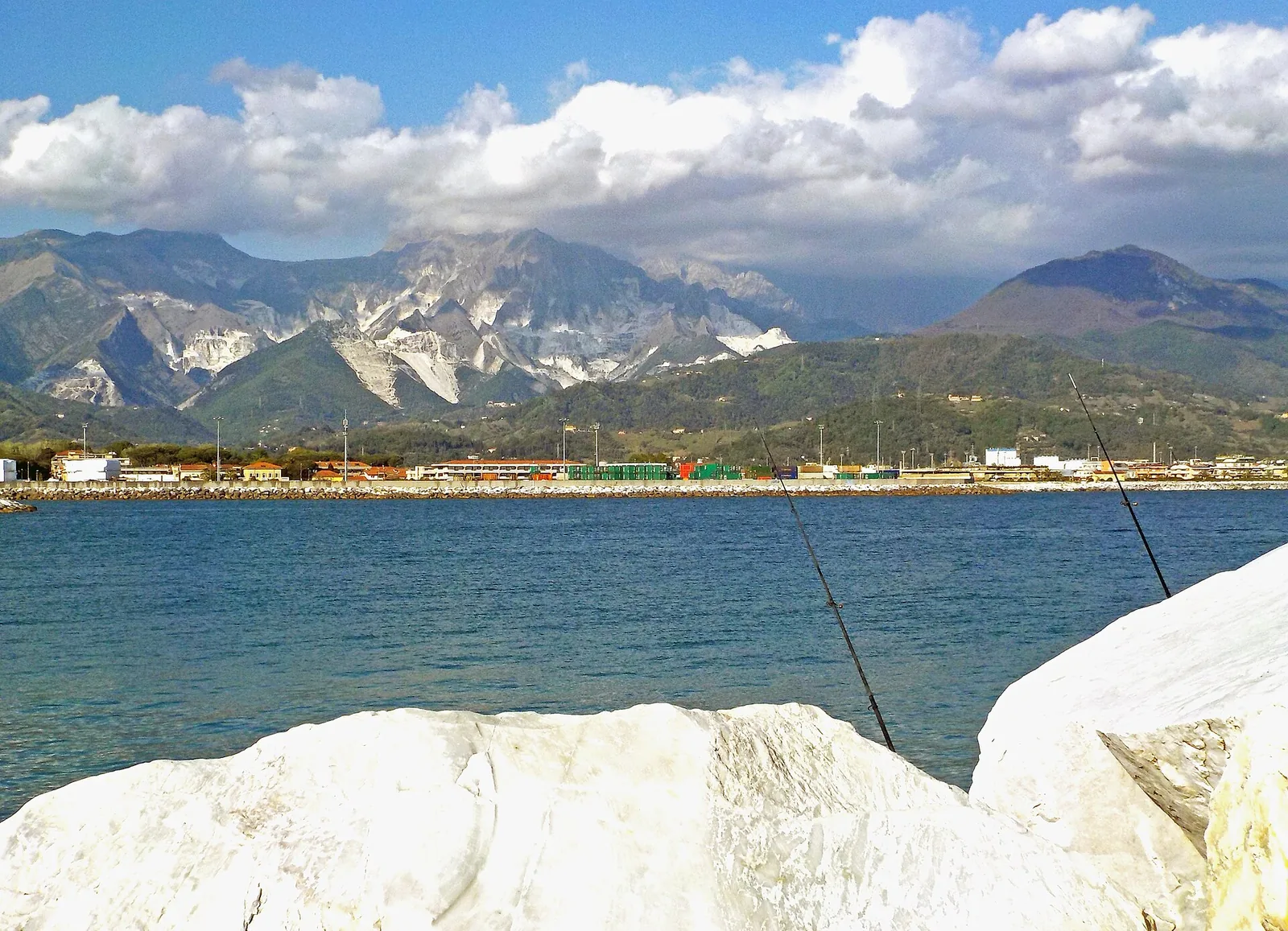
Marina di Carrara is a seaside resort on the Apuan coast facing the Ligurian Sea, a frazione of the comune of Carrara. The stretch between the port area and the border with Liguria is a wide sandy beach equipped with umbrellas and beach cabins. For most of its length it is run by private bathing establishments. The reference point of the beach faces south-west.
The frazione is part of an urban area broken up by pine woods and parks, which runs without interruption from the sea to the centre of Avenza. To the west, the built-up area of Marina di Carrara merges with the Ligurian resort of Marinella di Sarzana. The large pine woods within the town are typical of the coastal towns of Versilia. The seafront is formed by Viale Cristoforo Colombo and Viale Giovanni da Verrazzano.
Marina di Carrara, formerly known as Marina di Avenza, was founded at the wish of Francesco III, Duke of Modena. In 1851 the English industrialist Guglielmo Walton had the first large pre-port structure built, a long loading pier where ships could dock. From the nineteenth century onwards, the village was built on the seashore as a summer holiday resort. Three long loading piers were built on the sandy beaches of the coast, replaced in the thirties of the last century by a masonry port on the border with the comune of Massa. In 1881 the frazione had 1 590 inhabitants, while according to Wikipedia it now has about 15 000 over an area of 4.97 km².
Getting there
Marina di Carrara lies right next to the Carrara exit of the A12 motorway. By train, you arrive at Carrara-Avenza station, on the Genoa-Pisa line operated by RFI. The station is in the centre of Avenza. Avenza is 2.6 km as the crow flies north-east of the beach.
According to Wikipedia, the public transport network in the area is part of the regional AT-bus network. Wikivoyage states that within the comune the service is operated by Autolinee Toscane.
The comune's page on Marina di Carrara, updated in 2024, states that, being a seaside resort, there are no fees or opening hours to access it.
When to go
The local climate is tempered by the sea, which opens the way to the warm currents of the Mediterranean. The annual temperature range is around 10-15 °C. Rainfall peaks in November and is lowest in July, with secondary peaks in February and May. The coast receives about 1100 mm of rain a year.
Visit Tuscany reports that in August the historical re-enactment of the Lizzatura takes place in the marble quarries. The Lizzatura was the method quarrymen used to move marble blocks by sliding them over soaped wooden boards, before carrying them down to the valley in ox carts. During the sea turtle breeding season, volunteers from various associations comb the beaches in the early hours of the day, before the beaches are cleaned and the bathers arrive.
Seabed and sea
The coast, washed by the Ligurian Sea, has wide sandy beaches. The Apuan Riviera is a 20 km stretch of coast, with bathing establishments and opportunities for sports such as sailing and windsurfing. According to the EEA, the European Environment Agency, in the 2025 season the water at the monitoring point associated with the beach was rated excellent. The coastline appears in the FEE's 2026 Blue Flag (Bandiera Blu) list under the entry «Carrara - Marina di Carrara Centro/Ovest».
With the south wind (ostro), the south-westerly libeccio and the westerly ponente the beach is exposed, because the wind blows in from the sea and raises waves. With the tramontana, the grecale and the levante it is sheltered instead, because the wind blows from the land and the sea close to shore tends to be calmer. The scirocco and the maestrale blow across the beach. This is an indication based on the orientation of the coast, not a weather forecast.
Facilities and free beach
Visit Tuscany lists a Bau Beach in the Marina di Carrara area, a stretch of coast designed for people travelling with their dogs. The area overlooks a stretch of sea suitable for swimming and includes both a free-access section of beach and spaces that can be equipped. Regional rules allow dogs on a leash, under their owners' responsibility, in public outdoor areas, beaches included. Local rules still apply, however, and they are not the same for every beach. It is worth checking the rules in force before taking a dog to the beach.
Rules and protected areas
In August 2025 the comune announced an ordinance signed by the mayor of Carrara to protect the nesting sites of the loggerhead sea turtle (Caretta caretta). The ordinance laid down a series of bans, until the eggs hatched, on the section of beach identified as a nesting site by staff of WWF Alta Toscana.
It was forbidden to occupy the fenced area around the nest with umbrellas, chairs, deckchairs, boats and similar equipment. Within 5 metres of the nest, no structures such as fences could be placed that would obstruct the passage of the surveillance staff, while umbrellas, tents and deckchairs were not considered an obstacle. Also banned were games that could damage the nest, leaving boats other than rescue craft, vehicle traffic, and camping with tents and caravans. Around the nest, animals could not be left loose or walked without a leash, even if muzzled. Night-time lights, around hatching time, were not to interfere with the newly hatched turtles.
In the 2025 season, by 4 August, 33 Caretta caretta nests had already been recorded in Tuscany, 8 of them in the province of Massa-Carrara. On 27 July 2025 the first nesting in the comune of Carrara was recorded, on a beach near the port: the northernmost in the region. Anyone who sees a turtle leaving the water, or its tracks in the sand, can report it immediately to the coast guard on 1530. Approaching the turtles, touching them, photographing them with a flash or bringing dogs can make them return to the sea at once or disturb nesting. Artificial lighting along the coast at night can also disorient adult turtles and above all the hatchlings as they leave the nest.
Nearby
The Club Nautico of Marina di Carrara has produced sailors such as Luca Santella, the Chieffi brothers and Paolo Bottari. It is also an easily reachable, well-equipped landing place. At the entrance to the port stands the monument to the buscaiol, the day labourer who did heavy work in the port or in the marble quarries. Piazza Menconi is paved entirely in marble and has a fountain.
Carrara, 7 km as the crow flies north-east of the beach, is an internationally important centre for quarrying, processing and trading marble. In the town, the Civic Marble Museum is dedicated to the production and processing of marble in the Apuan Alps (Alpi Apuane). The Apuan range extends for 60 km along Versilia, Lunigiana and Garfagnana. Colonnata, a small quarrymen's village in the Apuan Alps, gives its name to Lardo di Colonnata IGP, which is left to mature in marble basins.
Massa is 8.4 km as the crow flies east of the beach. Bocca di Magra is 4.1 km as the crow flies to the west. In Luni you can visit the archaeological area of the Antica Città di Luni, with an amphitheatre, and the national archaeological museum.
Sources
- Wikipedia (it) — Marina di Carrara
- Wikipedia (en) — Carrara
- Wikipedia (it) — Carrara
- Wikivoyage (it) — Carrara
- Wikivoyage (en) — Carrara
- FEE Italia — Bandiera Blu 2026, elenco spiagge
- OpenStreetMap
- EEA — Bathing water quality 2025 (IT009045003001)
- QualeSpiaggia — open data spiagge (CC BY 4.0)
- Marina di Carrara - Comune di Carrara
- La nidificazione della tartaruga marina 'Caretta Caretta' tutelata da un’ordinanza firmata dalla sindaca di Carrara - Comune di Carrara
- Carrara | Visit Tuscany
- Apuan Riviera | Visit Tuscany
- Dog-friendly beaches in Tuscany | Visit Tuscany
- È l'estate dei record per i nidi di tartarughe marine in Toscana - ARPAT