
 43.464° N, 10.354° E


Complete guide
Cala del Leone: beach guide
What the beach is like
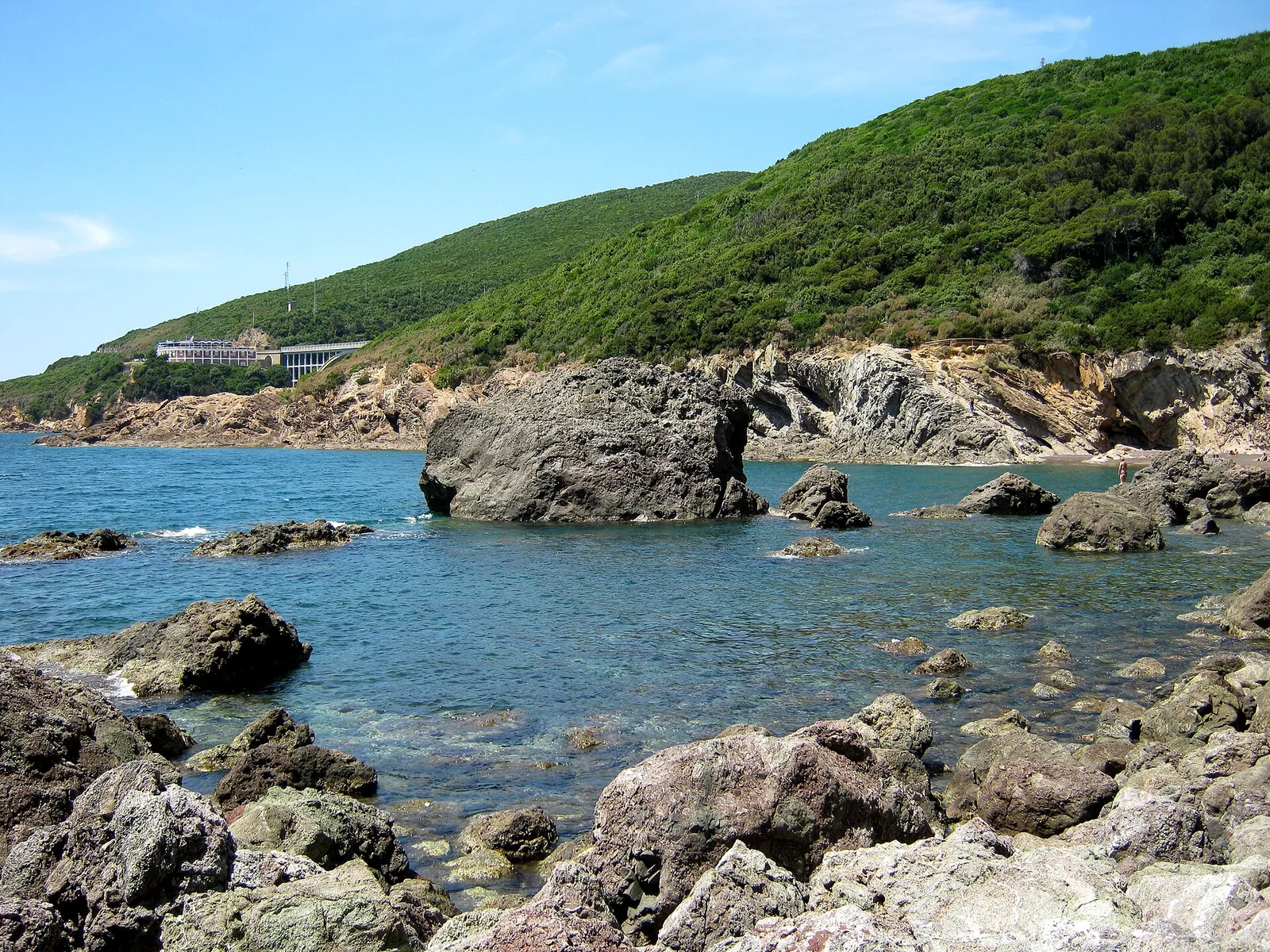
Cala del Leone is an inlet on the Livorno seafront, located between Calignaia and the headland of the Torre del Romito. On the headland stands the castle that belonged to Sidney Sonnino and his heirs. The name comes from Leone De Renzis Sonnino, Sidney Sonnino's nephew, who inherited his property in 1922 on condition that he take the double surname.
The cove is formed by cliffs, which are very common along the Livorno coast. On the northern side the Macigno sandstone crops out, in which the sequence of turbidite events is clearly visible. On the southern side, separated from the Macigno by a tectonic contact, there is instead an outcrop of the Ligurian unit, made of gabbro and covered by argillites and Palombini clays.
Getting there
The cove is in the locality of Il Romito, between Calafuria and the frazione of Quercianella, next to the Castello Sonnino. From the via del Littorale a tree-covered path leads down to the beach, with the last stretch made of steps cut into the rock. Quercianella is 1.2 km to the southeast as the crow flies and Calafuria 1.8 km to the northwest. Il Romito is the rocky stretch of coast that separates Quercianella from the city of Livorno.
By train, the Quercianella-Sonnino station, 1.8 km to the southeast as the crow flies, offers passenger service and serves the frazione of Quercianella. The centre of Livorno is 10.3 km to the north as the crow flies. For the descent you need suitable shoes, and it is best not to carry heavy loads.
When to go
The landscape and nature draw many visitors down to the cove, especially in summer. In the hottest hours it is best to tackle the path in the morning or late in the afternoon. Surfing is practised all year round on the Quercianella stretch of coast. In spring the Torre di Calafuria is frequented by pallid swifts, which use it for nesting.
Seabed and sea
According to QualeSpiaggia data, the cove faces southwest, onto the Ligurian Sea. With the southerly ostro, the southwesterly libeccio and the westerly ponente, the wind blows in from the sea, so the cove is exposed to waves and rough water. With the tramontana, grecale and levante the wind blows from the land, and close to shore the sea tends to be calmer. The scirocco and the maestrale, on the other hand, blow across the cove. These are indications based on the orientation of the coast, not weather forecasts.
In the 2025 season the European Environment Agency (EEA) rated the bathing water quality of this stretch as excellent. The sea along the stretch of coast of Quercianella, among rocks, shingle beaches and coves hidden in the greenery, has seabeds rich in fish that are popular for diving and snorkelling.
Facilities and free beach
In QualeSpiaggia data, derived from OpenStreetMap, no bathing establishments, car parks or showers are recorded for the cove. It is a good idea to bring water, shade and everything you need for the day. In Quercianella, by the small harbour, there is a beach with a free section and an equipped one. Quercianella's small port is a safe mooring for boats. The shingle beach of Rogiolo, 0.5 km to the southeast as the crow flies, also has access for disabled people and can be reached on a footpath along the rocks from the La Baracchina restaurant. In 2026 Rogiolo also appears, together with Cala Quercianella, in the FEE list of Bandiera Blu (Blue Flag) localities of the municipality of Livorno.
Rules and protected areas
Among the trails of the Monti Livornesi nature reserve is the route of the Site of Community Importance (SIC) «Calafuria – area terrestre e marina». The Monti Livornesi park spreads over the hills behind the city and also extends into the municipalities of Collesalvetti and Rosignano Marittimo. Along the coast, adjoining the park, lies the Calafuria nature reserve. It is best not to linger under the cliffs and to take care on the steps.
With children
Near the small harbour of Quercianella there is a little beach with a saltwater pool, created with an artificial barrier of large rocks, where children can swim comfortably.
Nearby
The Castello del Romito, also known as Castello Sidney Sonnino, is in the locality of Romito, near Quercianella. To protect the coast from pirate raids, Cosimo III de' Medici had a fortified castle built, starting from an existing tower. The complex then passed to the Lorraine family, in 1799 to the French and in 1895 to Sidney Sonnino, who was finance minister and prime minister of the Kingdom of Italy. During his lifetime Sonnino had a sea-view sarcophagus built in a natural cave, where he now rests.
The Torre di Calafuria, 2 km to the northwest as the crow flies, is an old lookout post about 20 m high, built by the Medici to defend the coast between Antignano and Quercianella. From here starts a 6 km, 4-hour walking route of medium technical difficulty because of the dirt paths and the climb, suitable for fit hikers. From the panoramic paths you can see the Tuscan Archipelago.
Along the coast, the Spiaggia del Sonnino is 0.4 km to the southeast as the crow flies, Calignaia 0.5 km to the west and Sassoscritto 0.9 km to the west. Antignano, 4.1 km to the northwest as the crow flies, is the southernmost district of the city and a very popular seaside resort. According to Visit Tuscany, Quercianella has held the Bandiera Blu since 2007 for the quality of its services and water. Castiglioncello is 7.9 km to the southeast as the crow flies.
Sources
- Wikipedia (it) — Cala del Leone
- Wikivoyage (it) — Livorno
- FEE Italia — Bandiera Blu 2026, elenco spiagge
- OpenStreetMap
- EEA — Bathing water quality 2025 (IT009049009019)
- QualeSpiaggia — open data spiagge (CC BY 4.0)
- Itinerario tra mare e terra a Calafuria | Visit Tuscany
- Quercianella | Visit Tuscany
- Castello Sidney Sonnino | Visit Tuscany