
 44.387° N, 12.320° E


Complete guide
Lido di Dante: beach guide
What the beach is like
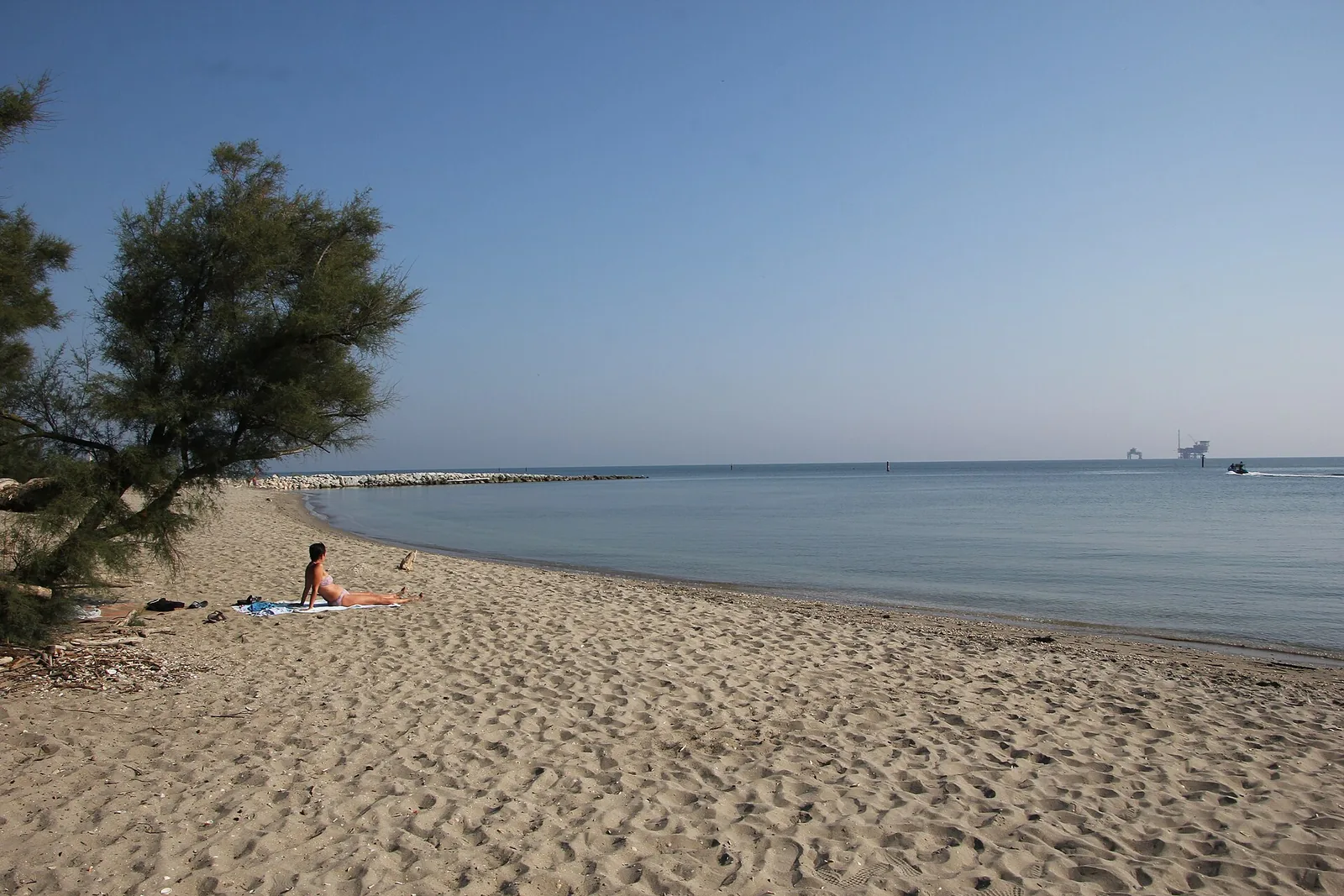
Lido di Dante is a frazione (hamlet) of the comune of Ravenna, on the Romagna Riviera. The resort lies between the mouth of the Fiumi Uniti, formed by the Ronco and the Montone, and that of the Bevano. The resort lies within the protected area of the Parco del Delta del Po. Emilia Romagna Turismo describes it as a destination for those looking for a holiday centred on peace and quiet and nature. The beach is sandy and faces east, onto the Adriatic Sea.
Lido di Dante is known above all for the Bassona beach, which partly includes the Classe pine forest. The Bassona was singled out in 2003 by Legambiente and later chosen, together with ten others, among the most beautiful beaches in Italy. The Bassona beach lies 1.6 km as the crow flies south of the Lido di Dante beach. For Emilia Romagna Turismo, it is in this area that Lido di Dante truly shows what it is.
Getting there
The resort can be reached by a turn-off from the SS 309 Romea state road. Ravenna lies 9.9 km as the crow flies west of the beach, while the village of Lido Adriano is 3 km to the north.
A walk links Lido di Dante with Ravenna along the embankments of the Fiumi Uniti. The route is almost 9 km long, runs past traditional fishing huts and private vegetable gardens, and is very popular with runners and walkers.
To reach the Bassona from the centre you need to go beyond the first beach establishments, walking along the beach or through the pine forest. According to Emilia Romagna Turismo, you get around on foot or by bike, because cars are banned. It is therefore worth planning the last stretch without a car.
When to go
Based on the orientation of the coast, the beach is exposed to the grecale (north-east wind), the levante (east wind) and the scirocco (south-east wind), which come in from the sea and can bring waves. With the libeccio (south-west wind), the ponente (west wind) and the maestrale (north-west wind), the wind instead blows from the land and the beach is sheltered, with calmer water close to shore. The tramontana (north wind) and the ostro (south wind) blow across the shoreline. This is an indication based on orientation, not a forecast.
According to the Emilia Romagna Turismo page, updated in 2023, the mobile tourist information office (IAT) of Lido di Dante is open from June to September. At the mouth of the Bevano the balance between water, sand and mud changes with the seasonal pattern of tides and river flow.
Seabed and sea
The beach floor is sandy. In the 2025 season the European Environment Agency rated the bathing water quality of this stretch as good. The sea here is the Adriatic.
The Natura 2000 site of Ortazzo, Ortazzino and the mouth of the Bevano also includes the coastal marine strip for a width of about 300 metres. The same site includes six kilometres of active coastal dunes, backed by a young coastal pine forest made up mainly of maritime pine. Before going into the water it is worth checking the sea conditions and the flags flown by the lifeguard service.
Facilities and free beach
Wikipedia states that the resort has four beach establishments on the beach of the built-up area and another 500 metres of free beach. According to Emilia Romagna Turismo, apart from the small built-up area, the resort has very few beach establishments and the rest is all free beach. In Lido di Dante there are no luxury hotels or residences, but terraced houses, mostly for rent, and numerous camper van pitches.
The naturist beach FKK Lido di Dante, where naturism has been practised since 1977, lies 0.9 km as the crow flies south of the beach. It is the only authorised naturist beach in the comune of Ravenna, equipped with toilets and a lifeguard service. There is also Camping Classe FKK, a section of Camping Classe Village reserved for naturist holidaymakers.
In 2026 the Lido di Dante/Lido di Classe stretch appears in the list of Blue Flag (Bandiera Blu) beaches awarded by the FEE for the comune of Ravenna.
Rules and protected areas
For decades the Bassona area has been a destination for naturists, and the practice is now officially recognised by the comune of Ravenna.
According to the Parco del Delta del Po, the Ortazzo, Ortazzino and Bevano mouth site is one of the few entirely free of beach establishments and with regulated access. It includes the Ortazzo e Ortazzino protection oasis, covering 800 hectares, a state nature reserve of 172 hectares and a wetland of international importance under the Ramsar Convention, covering 430 hectares. The site lies almost entirely within the Delta del Po regional park, in the Pineta di Classe e Saline di Cervia section. In protected areas, keep to the marked paths and respect the dunes.
Nearby
For the Parco del Delta del Po, the mouth of the Torrente Bevano is the last meandering estuary of the northern Adriatic that is free to evolve naturally. A recent nature-based engineering project has partly redirected its outlet to the sea to protect a stretch of dunes. The river mouth itself covers about 40 hectares. The Ortazzo was once a freshwater lagoon obtained from former rice fields and today it is a large back-dune lagoon, affected by brackish groundwater. Emilia Romagna Turismo recommends guided visits to the mouth of the Bevano and to the Ortazzo and Ortazzino oases, with birdwatching by canoe or electric boat and routes on foot and by bike.
Behind the dunes lie the state-owned Ramazzotti and Savio pine forests, created from the early twentieth century under the Rava law to protect crops from sea winds. In 2012 the Ramazzotti pine forest was almost completely destroyed by a fire. Further inland lies the Pineta di Classe, which today covers 900 hectares and forms a single large woodland, discontinuous in places. The Pineta di Classe is a remnant of the great historic pine forest that once stretched from the Reno to the Savio. In the countryside there is also the Torraccia, the only coastal defence tower surviving in the area, built in 1670 and now isolated among the fields.
The village of Classe lies 6.6 km as the crow flies west of the beach. In Ravenna, the complex of early Christian monuments has been on the UNESCO World Heritage list since 1996.
Sources
- Wikipedia (it) — Lido di Dante
- Lido di Dante | Emilia Romagna Turismo
- QualeSpiaggia — open data spiagge (CC BY 4.0)
- OpenStreetMap
- Sito di Interesse Comunitario e Zona di Protezione Speciale Ortazzo, Ortazzino, Foce del Torrente Bevano | Parco del Delta del Po
- EEA — Bathing water quality 2025 (IT008039014007)
- FEE Italia — Bandiera Blu 2026, elenco spiagge
- Zona Speciale di Conservazione e Zona di Protezione Speciale Pineta di Classe | Parco del Delta del Po
- Wikipedia (it) — Ravenna