
 39.208° N, 9.170° E


Complete guide
Poetto: beach guide
What the beach is like
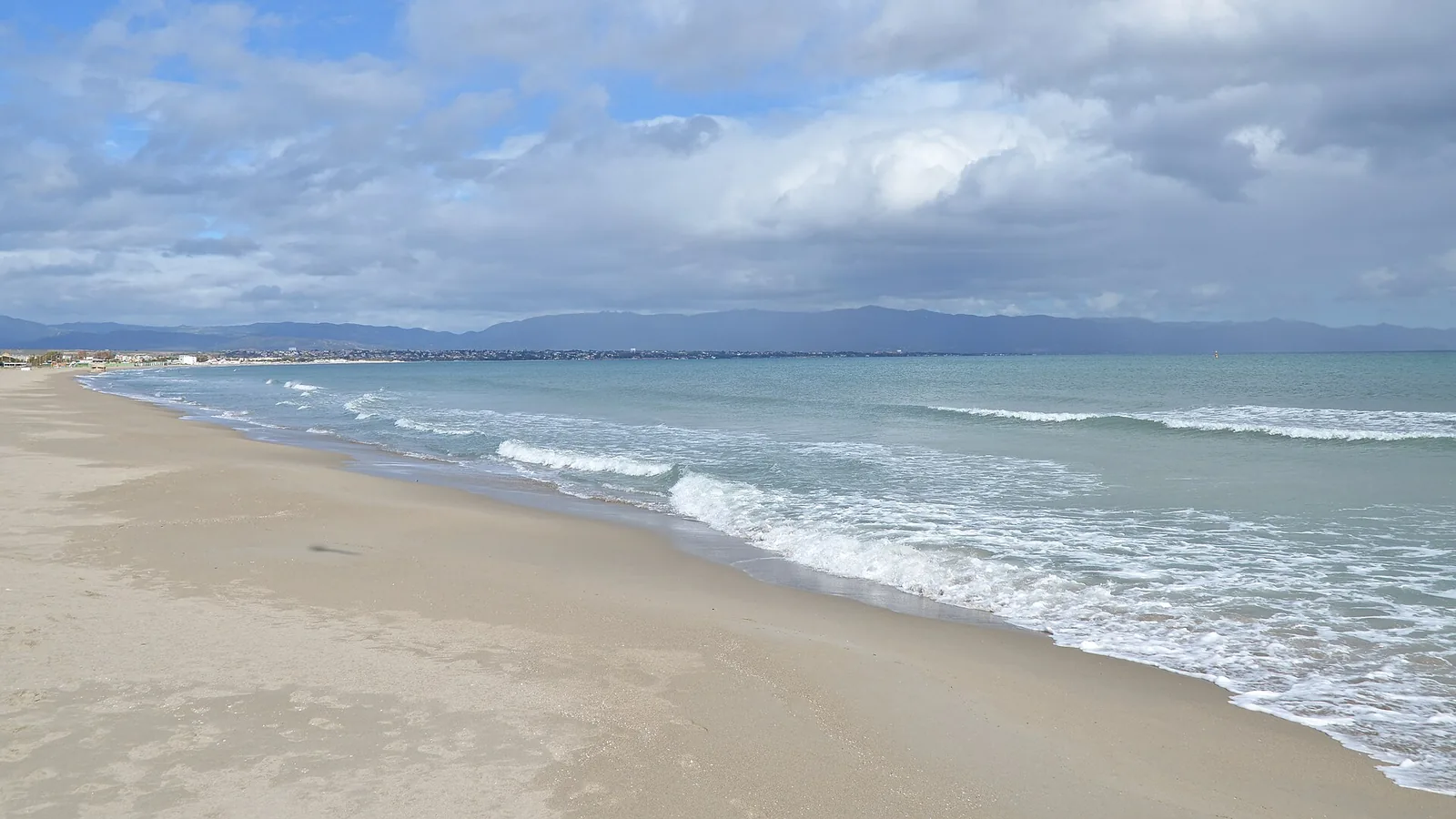
Poetto is a beach in the metropolitan city of Cagliari, split into the Poetto di Cagliari and the Poetto di Quartu Sant'Elena. It is a narrow strip of sandy beach about 8 km long on the golfo degli Angeli, running from the Sella del Diavolo, in Cagliari's territory, to the Quartu frazione of Margine Rosso. The shoreline is split into equal parts, between the almost four kilometres in Quartu and the four on the Cagliari side. The beach separates the salt pans and ponds of Molentargius from the sea. The shore is wide along its entire length. It is nicknamed the spiaggia dei Centomila (beach of the hundred thousand) because of its size and capacity.
According to Wikipedia, the name comes from the Sardinian Poétu, in turn from the Catalan Pouet, diminutive of Pou, meaning well. According to SardegnaTurismo, it might also come from the Spanish tower known as the poet's tower, although the hypothesis considered most likely is the Spanish puerto, port.
The area's traditional activity was salt extraction, which began in Roman times and ended in 1985. Before 1900 Poetto lay entirely within the territory of Quartu Sant'Elena and was little visited by the people of Cagliari, who preferred the western part of the gulf. From the first decades of the twentieth century the first bathing establishments appeared, the Lido and the D'Aquila, followed by the casotti, colourful wooden structures halfway between a changing room and a tiny house by the sea. On 2 August 1985 the beach was declared unhealthy, and the casotti were completely removed in March 1986 for health and hygiene reasons. A 1989 study traced the degradation of the shore back to the fifties, when post-war reconstruction led to massive sand extraction. With the beach nourishment attempted in 2002 on the Cagliari side, the very fine white sand of the past was replaced by a mixture of different colour and grain size, with fragments of shells and marine concretions.
Getting there
Poetto can be reached on the CTM lines PQ, PN and PF, which leave from piazza Matteotti, on via Roma. There is also the Poetto Express (PE) line, introduced in 2015, and in summer the lines to Poetto are reinforced. Poetto is also served by a cycle path linking it to Quartu Sant'Elena, where, however, the dedicated lane merges into traffic without protection.
By car, from via Roma you take viale Cristoforo Colombo towards viale Salvatore Ferrara and continue towards viale Poetto, then at the roundabout you take the third exit onto via San Bartolomeo, which continues as via Tramontana. You then turn right towards viale Poetto and at the next roundabout take the third exit onto via Lungo Saline, along which the beach is on the right. From Quartu Sant'Elena you take viale Colombo towards Poetto. A limited traffic zone at Poetto is also reported. From the beach's reference point, Cagliari is 5 km to the west as the crow flies and Quartu Sant'Elena 3.9 km to the northeast.
When to go
Poetto attracts visitors in summer and on any sunny day during the rest of the year. Even in the winter months it is frequented as a meeting place. Especially from June to September there are live music, discos, dance lessons and karaoke. The stretches of beach at the sixth and seventh stops, where the old Ospedale Marino also stands, are less crowded and quieter.
Seabed and sea
The water is clear and the seabed is sandy and shallow for tens of metres. The beach faces southeast, onto the Tyrrhenian Sea. With the easterly levante, the southeasterly scirocco and the southerly ostro, the wind blows in from the sea, so the beach is exposed to waves and rough water. With the tramontana, ponente and maestrale the wind blows from the land, and close to shore the sea tends to be calmer. The grecale and the libeccio, on the other hand, blow across the beach. These are indications based on the orientation of the coast, not weather forecasts.
According to SardegnaTurismo, Poetto is a beach break for wave surfing and kitesurfing and hosts world-class events. In the 2025 season the European Environment Agency (EEA) rated the bathing water quality at the reference sampling point for the beach as excellent. The 1997 and 1999 updates to the erosion study also listed among the causes of the degradation the increase in wave action due to the disappearance of Posidonia oceanica.
Facilities and free beach
Poetto is popularly divided into fermate (stops), named after the old tram stops; the tram was later replaced by buses. The second and third stops are home to the historic D'Aquila and Lido establishments, the fourth to those of the police and law-enforcement agencies, and from the fifth, where the Spanish tower stands, to the end of the line there is a stretch of free sand. The boundary with the Quartu shoreline is La Bussola, the name of a venue that has since closed, and from here free beach alternates with equipped establishments.
Behind the beach runs a seafront promenade for walking, skating or cycling, suitable for jogging, rollerblading and skateboarding. The traditional kiosks offer refreshments and entertainment. Toilets and showers are available, and there are areas set aside for dogs. Facilities include bathing establishments, a diving centre, sailing schools, boat hire, beach tennis and volleyball courts, canoe trips, fast food outlets, restaurants and a funfair open all year. The beach clubs rent out umbrellas and deck chairs and clean the sand every night.
Rules and protected areas
The Molentargius-Saline regional nature park is a wetland of about 1600 hectares, bounded by the urban growth of Cagliari, Quartu Sant'Elena, Selargius and Quartucciu and by the Poetto seafront. According to the park authority, in recent years the Molentargius pond has been the most important site in the Mediterranean for flamingo nesting. In the park dogs must be kept on a lead, because free-roaming dogs disturb wild birds. The park has an entrance on the seafront and can be visited on guided or self-guided tours by bike and on foot, on boat routes along the canals of the former salt pans and by electric bus. The Molentargius pond is 1.4 km northwest of the beach as the crow flies.
With children
Thanks to the shallow seabed, SardegnaTurismo considers the beach ideal for children to play. The first stop has a very shallow seabed. With small children, it is best to choose a stretch with a lifeguard and keep an eye on the flags.
Nearby
The Sella del Diavolo, 2.4 km to the south as the crow flies, towers over Marina Piccola, where SardegnaTurismo recommends a stroll around the small harbour. From Calamosca you can climb to the seventeenth-century tower at the top of the headland on a one-hour route. On the opposite side of the Sella are the sheltered little beaches of Calamosca and Cala Fighera. Calamosca is 2.8 km to the southwest as the crow flies. At the other end of the shoreline, Margine Rosso is 5.7 km to the northeast as the crow flies. The Molentargius park is a wetland with freshwater and saltwater basins, with a footpath and bikes for hire at the info point.
Sources
- Wikipedia (it) — Poetto
- Wikipedia (en) — Poetto
- Wikivoyage (it) — Cagliari
- Wikivoyage (en) — Cagliari
- OpenStreetMap
- EEA — Bathing water quality 2025 (IT020092009004)
- QualeSpiaggia — open data spiagge (CC BY 4.0)
- Poetto | SardegnaTurismo - Sito ufficiale del turismo della Regione Sardegna
- Spiaggia del Poetto - Italia.it
- Home Page | Parco Naturale Regionale Molentargius-Saline