
 40.717° N, 13.861° E


Complete guide
Spiaggia di Citara: beach guide
What the beach is like
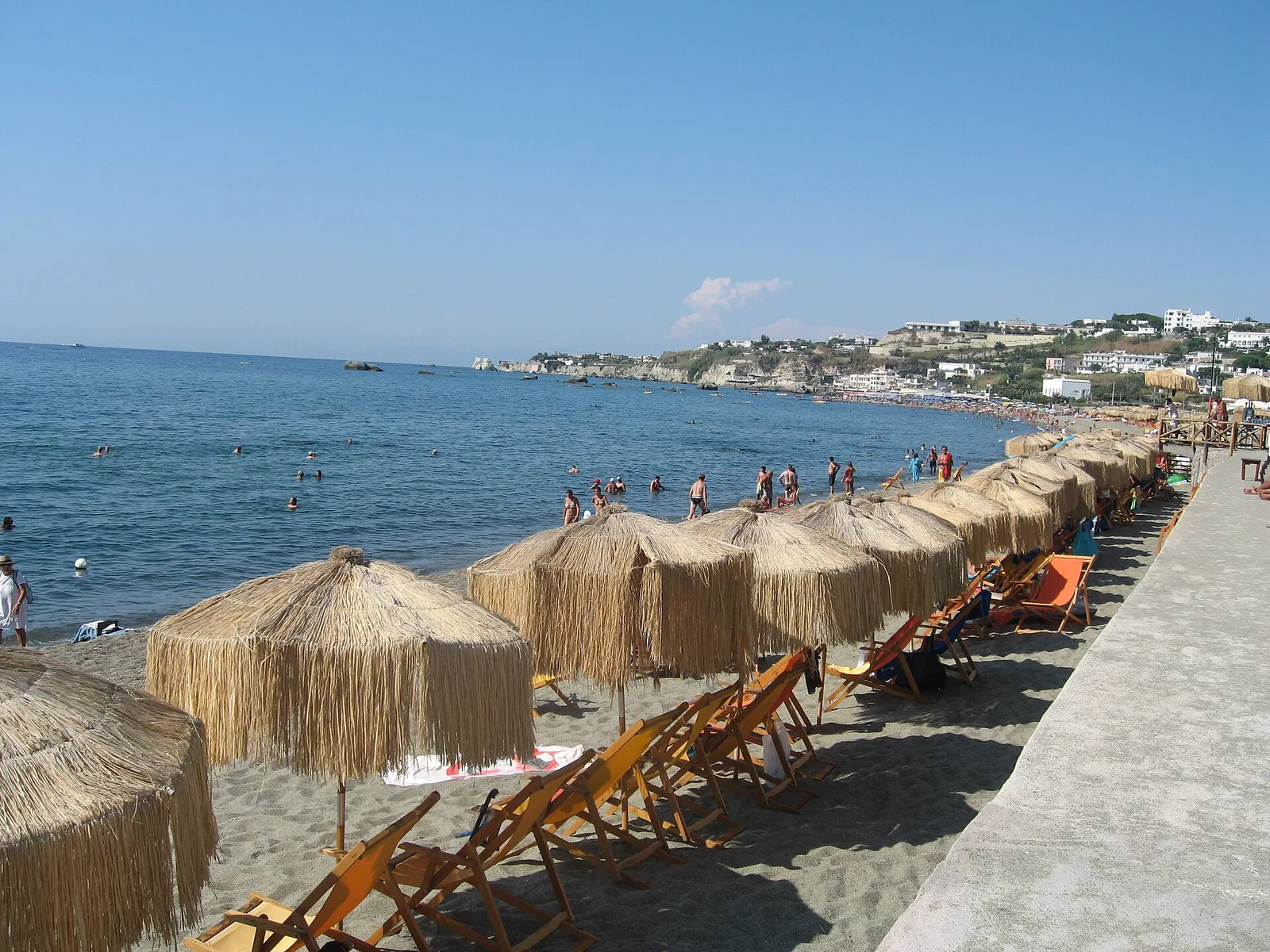
The Spiaggia di Citara lies in the municipality of Forio, on the island of Ischia, in the province of Naples, in Campania. It lies near Punta Imperatore and the village of Panza. The beach faces the Tyrrhenian Sea. The strip of sand stretched for more than a kilometre, closed off by the Capizzo headland and by the more imposing one of Punta Imperatore with its old lighthouse. It is a long, winding beach: the coastline, high and steep at first, drops at Citara and then rises gently towards Forio. Wikivoyage places the beach at the foot of Epomeo and lists it as one of the most popular on the island.
According to Discover Campania, the Greeks of Pithekoussai chose to dedicate the site to the cult of Aphrodite, with a temple. A large white marble statue of the goddess, found on the shore, is said to have remained there until 1792, when it was destroyed. The link with Aphrodite has survived in the name Citara. The English-language Wikipedia traces the name back to the ancient Romans, who consecrated the site to the goddess, and mentions the discovery of the white marble statue. In the fourteenth century a document listed Citara among the five most active and frequented bathing spots on the island of Ischia.
Some rocks can be seen from the beach which, according to an old legend, were originally sailors turned to stone as a punishment. The large stones called white, black and red once lay within the coastline and now rise from the sea several tens of metres further out. The advance of the sea, linked to the slow sinking of the island, later submerged the site of the red stone, where there was also a salt works important to the local economy.
Getting there
The beach lies 2.2 km as the crow flies south of the centre of Forio. The village of Panza is 1.4 km as the crow flies south-east of the beach. To reach the island, Wikivoyage names the port of Ischia as the most commonly used, but notes that the port of Forio is also available. The reference airport is Naples, the closest to the island.
On the island, Wikivoyage writes, the two main bus routes are the CD and the CS: both start from Ischia Porto, circle the island and return to Ischia Porto. The CD runs clockwise around the loop, the CS in the opposite direction. The stops along the routes are every few hundred metres. Especially in summer, the bus may be delayed by traffic or be full.
When to go
According to QualeSpiaggia data, the beach faces west. With the south-west wind (libeccio), the west wind (ponente) and the mistral (maestrale), the wind comes from the sea and the beach is exposed to waves and rough sea. With the north-east wind (grecale), the east wind (levante) and the sirocco (scirocco), the wind blows from the land and the beach is sheltered, with calmer water close to shore. The north wind (tramontana) and the south wind (ostro) arrive across the shoreline instead. These are indications derived from the orientation of the coast, not weather forecasts.
The English-language Wikipedia notes the beach for its sun-catching position and limpid sea. According to Wikivoyage, the public areas of the beach are small and often overcrowded. On hot days it is worth bringing water, a hat and sunscreen.
Seabed and sea
The beach is sandy. For the 2025 season the European Environment Agency (EEA) rates the bathing water quality at Citara as excellent. In several places the seawater mixes with thermal water, so you can swim in the sea and benefit from the thermal water at the same time. Spring water also gushes into the sea.
In the valley lapped by the sea the thermal water would emerge as soon as one dug a few centimetres into the ground. The inhabitants of Pithekoussai regarded it as a healthy liquid and a source of fertility. Two centuries after that fourteenth-century mention, the Calabrian scholar Giulio Jasolino identified the characteristics of Citara's water and gave advice on its therapeutic use. From the 1930s interest grew in using the thermal vapours of Citara to produce electricity. A small thermoelectric power plant, little more than an experiment, operated from the end of the Second World War until 1956, when the idea was abandoned.
Facilities and free beach
According to Wikivoyage, much of the beach is privately owned. The Poseidon thermal gardens stand on the beach, with a series of seawater and thermal-water pools, according to the English-language Wikipedia. The same article states that the complex also has a large private beach equipped with deckchairs and umbrellas. The sources disagree on the number of pools and on the temperatures: the English-language Wikipedia mentions 22 pools with water between 28 and 40 °C, italia.it more than 20 thermal pools between 16 and 40 °C. According to italia.it, the park also has a sauna carved out of a tufa cave.
In the seventies the Bavarian doctor Ludwig Kuttner took care of the valley and the beach, creating the Poseidon gardens. Before him, the doctor Gernot Walde had created the first thermal park. It is worth bringing an umbrella and a beach towel.
Rules and protected areas
With the decree of 27 December 2007 the Ministry of the Environment established the "Regno di Nettuno" marine protected area, which covers the islands of Ischia, Vivara and Procida. The decree entrusts its management, on a provisional basis, to a consortium formed by the municipalities of Barano, Casamicciola Terme, Forio, Ischia, Lacco Ameno, Serrara Fontana and Procida. The activities permitted in the different zones are governed by a separate regulation, provided for by the same decree.
Nearby
The beach of Cava dell'Isola lies 1 km as the crow flies to the north. The Spiaggia della Chiaia is 2.8 km to the north as the crow flies, the Spiaggia dei Maronti 4 km to the south-east. Citara, together with the beaches of S. Francesco di Paola and Chiaia, is one of the beaches of Forio.
The Citara bay is also home to the Giardini Ravino, a botanical garden which, according to Wikivoyage, holds one of the richest collections of cacti and succulents grown outdoors on the European continent. On the Zaro headland are the Giardini La Mortella, designed and created by Lady Walton, wife of the composer William Walton. Sorgeto, in Panza, is a small bay at the foot of cliffs covered with agaves, where thermal water gushes into the sea. The bay is reached down a staircase, and the hot water mixing with the sea forms natural thermal pools.
Sources
- QualeSpiaggia — open data spiagge (CC BY 4.0)
- Wikipedia (en) — Citara
- Discover Campania - Da Afrodite a Poseidone, il regno dell’acqua che dà vita nella valle di Citara
- Wikivoyage (en) — Ischia
- EEA — Bathing water quality 2025 (IT015063031004)
- Thermal parks and beaches in Ischia: itinerary - Italia.it
- www.mase.gov.it — dm_27_12_2007_amp_regno_nettuno.pdf
- Forio, village in Campania: things to do - Italia.it