
 43.666° N, 10.276° E


Complete guide
Marina di Pisa beach: a guide
What the beach is like
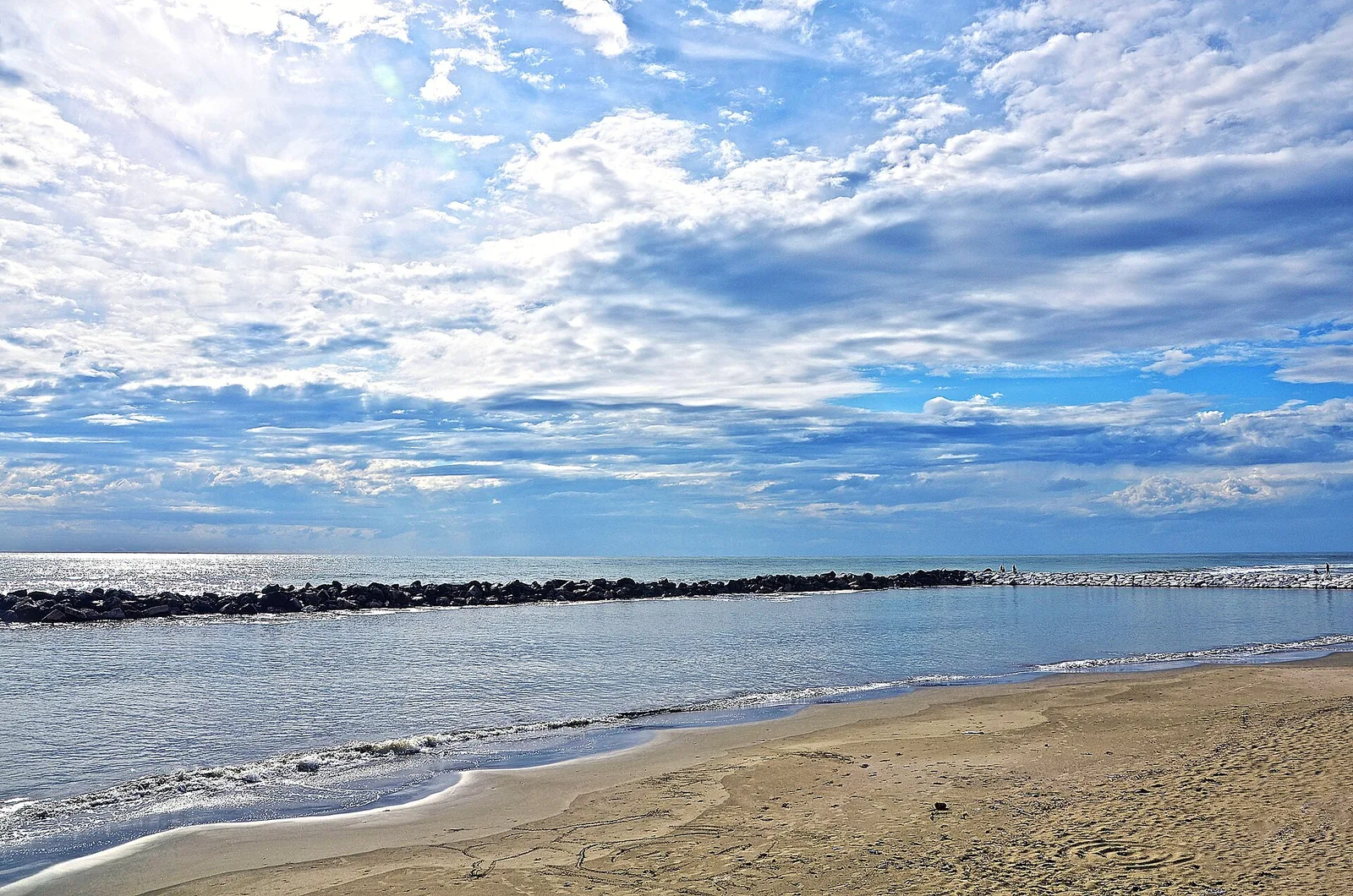
The beach of Marina di Pisa lies in the municipality of Pisa, in Tuscany, and faces the Ligurian Sea. The village of Marina di Pisa is 0.8 km as the crow flies north of the beach. Marina di Pisa is a frazione (hamlet) of the municipality of Pisa, known until the last century as Boccadarno because of its position at the mouth of the river Arno. The beaches of the resort are sandy or gravelly. There are small beaches surrounded by rock barriers that protect the coast from storm surges. In the southern part of the coastline the beaches are wider and sandy and host the beach clubs.
From Marina di Pisa you can see the islands of Corsica, Elba and Gorgona. The built-up area stretches along the coast from north-west to south-east and borders the frazione of Tirrenia to the south. Behind it lies the pine forest of the Pisan coast, the one that inspired D'Annunzio's lines in La pioggia nel pineto.
Marina di Pisa grew into a seaside resort from a fishing village in the second half of the nineteenth century. Its official founding dates back to 1872, when the Comune di Pisa drew up a grid-plan town layout punctuated by three squares. In 1892 the Pisa-Marina steam line was inaugurated, boosting tourism with the first restaurants, bathing establishments and guesthouses.
Getting there
Following viale D'Annunzio from Pisa towards the sea you reach Marina di Pisa after 11 km. As the crow flies, the centre of Pisa is 11.6 km from the beach, to the north-east. Marina di Pisa is crossed by the SP224 road, which runs from Pisa to Livorno. Livorno lies 13.1 km as the crow flies south of the beach.
For those arriving by train, the reference station is Pisa Centrale. According to Wikipedia, Marina di Pisa is served by frequent Autolinee Toscane buses linking it to Pisa, Tirrenia and Calambrone.
By bike you can follow the Trammino cycle route, a 13 km cycle path that takes you from the city to Marina di Pisa. The bed of the electric railway that ran along the coast until the sixties has been turned into a cycle path leading to Pisa and Tirrenia.
When to go
The climate of Marina di Pisa is Mediterranean, with south-westerly libeccio winds that cause fairly frequent storm surges. The beach faces west. With this orientation the libeccio, the westerly wind (ponente) and the mistral (maestrale) come in from the sea and can bring waves. The grecale, the easterly wind (levante) and the sirocco (scirocco) blow from the land instead: the beach is more sheltered and the sea close to shore tends to be calmer. The tramontana and the southerly wind (ostro) arrive from the side. This is an indication based on orientation, not a forecast.
According to Visit Tuscany, Marenia takes place along the whole Pisan coast from May to September, with events covering music, shows, culture and sport. Italia.it reports that on the last Saturday of June Marina di Pisa takes part with Tirrenia and Calambrone in the historical re-enactment of the Gioco del Ponte. The same portal states that between late July and early August the summer carnival of Marina di Pisa takes place, first held in 1927, with its parade of allegorical floats. According to Wikipedia, on holiday afternoons and every evening in high season the seafront, via Repubblica Pisana, is closed to traffic and becomes a promenade.
Seabed and sea
This stretch is made of small marble pebbles. The pebbles are smooth and do not hurt your feet, but they are slightly unstable at the water's edge. For this reason footwear suitable for sea water is recommended for walking on the beach and getting in and out of the water.
In the 2025 season the European Environment Agency rated the bathing water quality of this stretch as excellent. Marina di Pisa appears in the FEE's 2026 Blue Flag (Bandiera Blu) list for the municipality of Pisa, together with Calambrone and Tirrenia.
In the sixties, coastal erosion had wiped out a large part of the sandy beaches, and numerous breakwaters were needed to protect the town. In 2000 the municipal administration tried to curb erosion with a gravel beach, which was completely destroyed by the first storm surge. According to Wikipedia, since 2006 the breakwaters have been undergoing reinforcement and redesign. In Marina di Pisa fishing is practised mainly by local residents, and wedge clam (arselle) fishing is particularly important.
Facilities and free beach
Wikipedia notes that along the coast of Marina di Pisa there are free beaches, with sand or pebbles, and bathing establishments, many of which have food outlets. The marina at the mouth of the Arno has been open to the public since 30 June 2013 and has 344 berths.
According to Wikivoyage, there are several restaurants on the seafront and those arriving late in the evening may find no parking or free tables. According to Italia.it, in summer the resort comes alive with bars and clubs.
Rules and protected areas
The coast of the Terre di Pisa lies within the San Rossore Migliarino Massaciuccoli regional park, alternating beaches, dunes and Mediterranean scrub with the pine forest behind. The opposite bank of the river, facing the port area, is a protected zone and part of the park.
With children
For families with children, Visit Tuscany suggests the trails of the Parco avventura Pineto, in the shade of the park's pine forest. For teenagers it points to the funfair and the Sunlight water park in Tirrenia. On the pebbles, water shoes help even the youngest get in and out of the water.
Nearby
At the mouth of the Arno, in the area called Bocca d'Arno, stand the retoni, wooden fishing platforms with lift nets built by fishermen after the Second World War. The nets are lowered to the seabed and pulled up after a few minutes, and measure from 10x10 up to 22x22 metres.
In the village there are villas from the late nineteenth and early twentieth century, including Villa Bondi in piazza Baleari, built in 1909, Villa Galli Dunn from 1905 in Louis XIV style, the neo-Gothic Villa Albites and Palazzo Carovigno in piazza Gorgona.
The beach of Tirrenia is 3.1 km as the crow flies south of the beach of Marina di Pisa. In Tirrenia the beach, free or equipped with bathing establishments, becomes wider and features high dunes, such as the one in the Oasi WWF delle Dune. Calambrone, the last resort on the Pisan coast before Livorno, lies 8.1 km as the crow flies to the south. Its former seaside holiday camps, now converted into accommodation, retain the architecture of the Fascist era (Ventennio). The frazione of San Piero a Grado is 6 km as the crow flies east of the beach.
Sources
- Wikipedia (it) — Marina di Pisa
- Wikipedia (en) — Marina di Pisa
- Wikivoyage (en) — Pisa
- FEE Italia — Bandiera Blu 2026, elenco spiagge
- OpenStreetMap
- EEA — Bathing water quality 2025 (IT009050026003)
- QualeSpiaggia — open data spiagge (CC BY 4.0)
- Marina di Pisa - Italia.it
- Marina di Pisa | Visit Tuscany
- Il mare nel Parco: Marina di Pisa, Tirrenia e Calambrone | Visit Tuscany
- Marina di Pisa: i 'Retoni' a Boccadarno | Visit Tuscany