
 43.639° N, 10.286° E


Complete guide
Tirrenia beach: a guide to the beach
What the beach is like
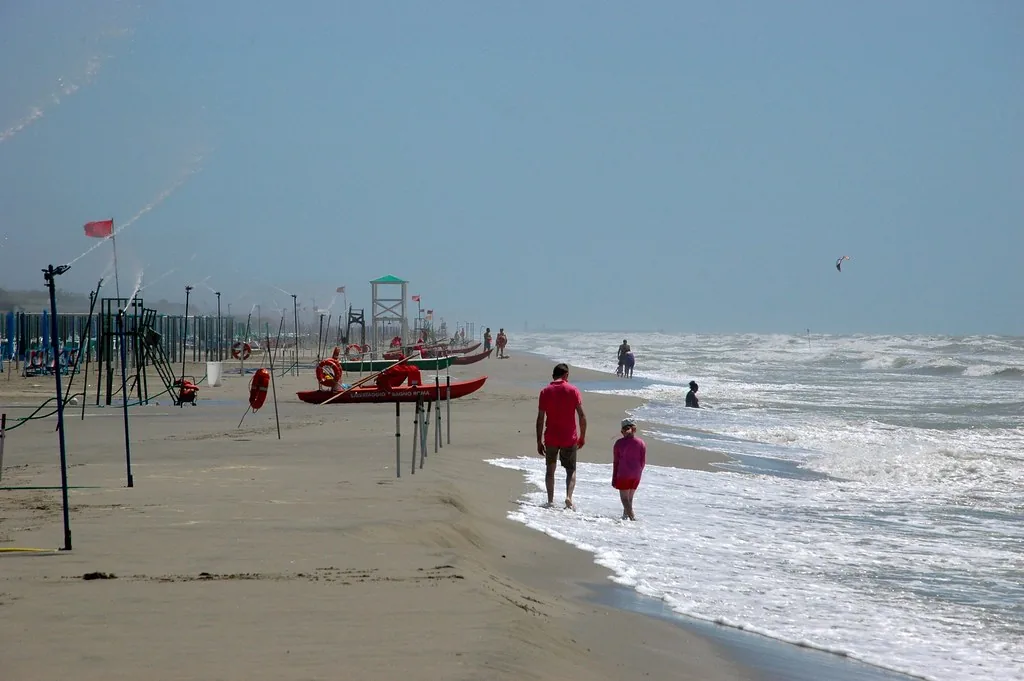
Tirrenia beach lies in the municipality of Pisa, in Tuscany, and faces the Ligurian Sea. The village of Tirrenia is 1.4 km as the crow flies south-east of the beach. Tirrenia is a frazione of the municipality of Pisa, a seaside resort founded in the thirties of the twentieth century. Its name comes from the Tyrrhenian Sea, to which this stretch of water is traditionally assigned, although hydrographic conventions place it in the Ligurian Sea. The village extends mainly along the coast and is bounded by Marina di Pisa to the north and by Calambrone to the south.
Visit Tuscany describes Tirrenia as a seaside resort set in a vast Mediterranean pine forest, a few kilometres from Pisa, known for its wide sandy beaches. The site adds that, as you continue from Marina di Pisa along the coast road, at Tirrenia the beach becomes wider and has high dunes of great natural importance. According to Wikipedia, the coast, with its sandy beach, is more than 5 km long and has plenty of facilities.
The frazione was founded on 3 November 1932 on an area that until then had been marshland. It was created at the wish of Costanzo Ciano and of Guido Buffarini Guidi, podestà of Pisa. Architects such as Adolfo Coppedè, Federico Severini and Antonio Valente gave the settlement a typically rationalist character. In 1933 the Tirrenia Film Studios were inaugurated; in 1934 they were taken over by Giovacchino Forzano under the name Pisorno. The studios closed in 1969, but the last film shot at the Tirrenia studios was Good morning Babilonia by the brothers Paolo and Vittorio Taviani, in 1987. In 1951 the American base of Camp Darby was established nearby.
Getting there
Tirrenia is crossed by the SP224, which links the towns of the Pisan coast between Calambrone and Marina di Pisa. The centre of Pisa is 12.6 km as the crow flies north-east of the beach, Livorno 10 km as the crow flies to the south. According to Visit Tuscany, the nearby Pisa-Galileo Galilei airport, the port of Livorno and the motorway network make Tirrenia easy to reach. According to Wikipedia, the frazione is served by frequent Autolinee Toscane buses, which connect it with Pisa and the rest of Tuscany.
By bicycle you can use the cycle path along the main avenue, which runs north as far as Marina di Pisa. Along the former trackbed of the old Pisa-Tirrenia-Livorno railway the path reaches Pisa, for a total route of 10 km, half of it through the pine forest of the regional park. From the central square the cycle path continues south for another 5 km, as far as Calambrone. From 1932 until the sixties the coast was served by the Pisa-Tirrenia-Livorno electric railway, known as the Trammino or Trenino.
When to go
The beach faces west. With this orientation the libeccio (south-west wind), the ponente (west wind) and the maestrale (north-west wind) blow in from the sea and can bring waves. The grecale (north-east wind), the levante (east wind) and the scirocco (south-east wind), by contrast, blow from the land: the beach is more sheltered and the sea close to shore tends to be calmer. The tramontana (north wind) and the ostro (south wind) blow across the beach. This is an indication based on orientation, not a forecast.
Tirrenia has a Mediterranean, moderate climate even in winter, mitigated by the sea. Wikipedia names the sandy beaches as the main attraction of the place, together with some pubs and discos open both in summer and in winter. Visit Tuscany mentions evening discos, bars and evening events organised by the bathing establishments by the sea. According to Wikivoyage, in summer nightlife starts in the historic centre of Pisa and then moves towards the coast, where discos, clubs and pubs are concentrated in Marina di Pisa and Tirrenia.
Seabed and sea
This stretch is a sandy beach. In the 2025 season the European Environment Agency rated the bathing water quality of this stretch as excellent. For the municipality of Pisa, the FEE Blue Flag (Bandiera Blu) 2026 list includes Marina di Pisa and the Calambrone/Tirrenia stretch.
The Tuscany tourism website mentions stretches of free beach where you can enjoy a clear blue sea. The activities possible in this stretch of sea include sailing and spearfishing. Fishing is also a source of income and is practised mainly by local residents.
Facilities and free beach
Tirrenia's wide beach has bathing establishments but also stretches of free beach. The American Beach in Tirrenia, a holiday venue for American and NATO troops, closed at the end of the 2014 summer season and became a free beach. For sport, Visit Tuscany lists facilities for beach volleyball, tennis, football and golf, as well as horse-riding circuits. Tirrenia is also home to the Olympic Training Centre of CONI, where many athletes and teams train.
Rules and protected areas
Tirrenia lies within the southernmost part of the Migliarino, San Rossore, Massaciuccoli nature park. The park is a vast natural area of 24 thousand hectares between Viareggio and Livorno. According to Wikipedia, the territory of Tirrenia contains one of the last dune environments in Italy, protected by a WWF reserve.
The Tirrenia dunes reserve (Oasi delle dune di Tirrenia) is a protected area managed by WWF Pisa, with trails for walks on foot, some of them also accessible to people with disabilities. Among the high dunes grow the species typical of the Mediterranean scrub, and animals and plants characteristic of dune environments live there. The typical dune plant species found in the reserve are still protected. On the dunes it is best to stay on the paths and not to tread on the vegetation.
Over the last 20 years the maritime pines of the pine forest, planted in the Lorraine era, have been felled because of Matsucoccus feytaudi, a scale insect that kills the tree.
With children
For teenagers, according to Visit Tuscany, the funfair and the Sunlight water park offer entertainment. With small children it is best to bring water, a hat and sun cream.
Nearby
Marina di Pisa beach is 3.1 km as the crow flies to the north. Marina di Pisa is a small seaside resort that grew from a fishing village in the mid-nineteenth century, with small beaches of sand or gravel. Calambrone is 5 km as the crow flies to the south and is the last locality on the Pisan coast before Livorno. During the Fascist era it was known for its seaside holiday colonies, which, although converted into accommodation, still retain the architecture of the Ventennio. Numerous summer colonies were also built in the southernmost part of Tirrenia, on the border with Calambrone.
Behind the village lay the agricultural estate Fattoria di Tirrenia, owned by the counts Gabrielli di Quercita, an example of rationalist architecture. Under the name Azienda agricola di Tirrenia, the farm is still in operation and has been converted into an agriturismo.
Sources
- Wikipedia (it) — Tirrenia
- Wikipedia (en) — Tirrenia
- Wikivoyage (it) — Pisa
- FEE Italia — Bandiera Blu 2026, elenco spiagge
- OpenStreetMap
- EEA — Bathing water quality 2025 (IT009050026006)
- QualeSpiaggia — open data spiagge (CC BY 4.0)
- Tirrenia | Visit Tuscany
- Il mare nel Parco: Marina di Pisa, Tirrenia e Calambrone | Visit Tuscany